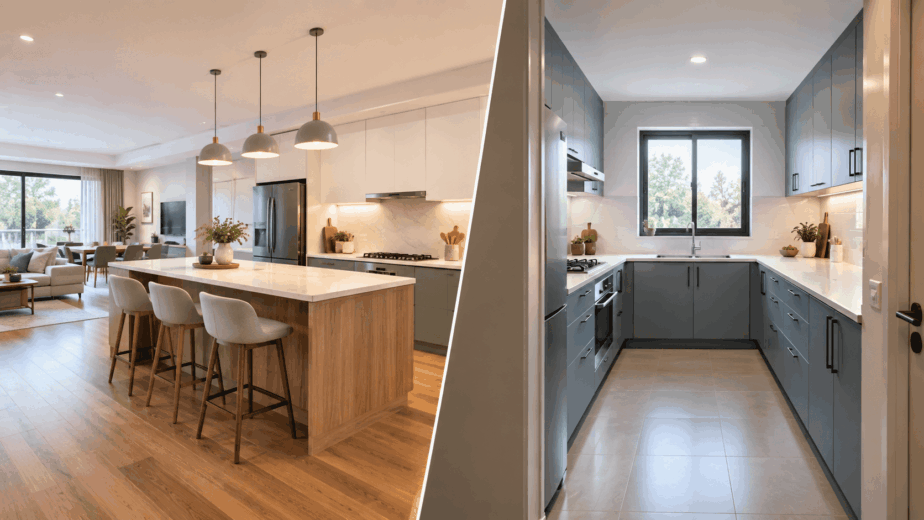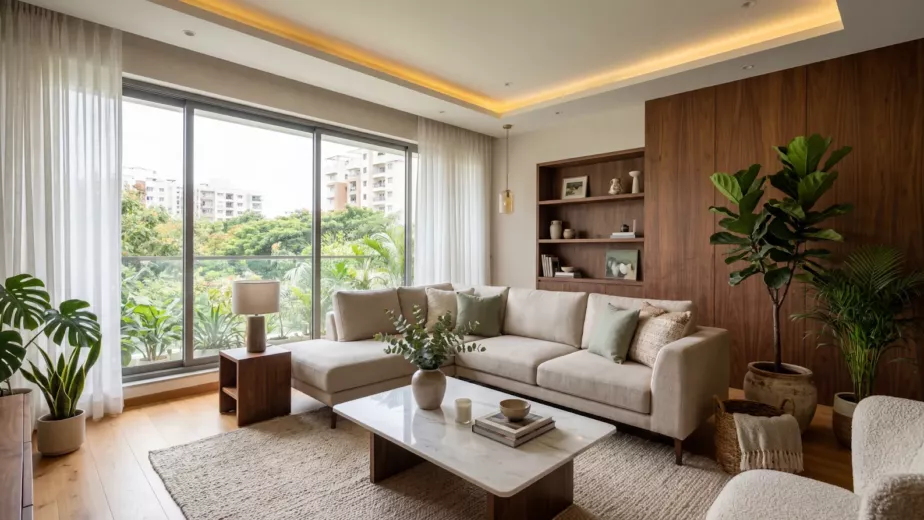

Choosing an interior design company in Bangalore is one of the biggest decisions you’ll make for your home – and most people underestimate just how much rides on it. The right firm transforms how you live; the wrong one costs you months, money, and genuine peace of mind. This guide walks you through everything: the types of firms operating in Bangalore, what a real full-service process looks like, what to watch out for, how pricing actually works, and the questions you must ask before signing anything.
TL;DR
- Bangalore has four main types of interior design companies – design-only, turnkey, online-first platforms, and freelancer networks – and they serve very different needs.
- Full-service turnkey firms handle everything from concept to handover; knowing what’s included (and what isn’t) protects your budget.
- Interior design costs in Bangalore range from Rs.1,200 to Rs.4,500+ per square foot in 2026, with villa and premium projects sitting at the higher end.
- Red flags like vague contracts, no project manager assigned, and no site visit policy should stop any conversation before it starts.
- Pricing models vary widely – per sq. ft., percentage-based, and package-based – and each requires a different reading approach.
- Line of Thought operates as both an interior designer in Bangalore and a construction company in Bangalore, which means fewer coordination failures and more predictable outcomes.
Why the Interior Design Company You Choose Changes Everything
Here’s something that doesn’t get said enough: most interior design disasters in Bangalore aren’t caused by bad taste. They happen because of poor coordination, unclear contracts, and the fundamental mismatch between what a client expects and what a firm is actually equipped to deliver.
Think about the stakes for a moment. You’re trusting another team with your home – your kitchen, your bedroom, the space your children play in. You’re spending anywhere between a few lakhs and several crores, depending on the scope. You’ll live with the results every single day for years. And in many cases, you’ll be displaced or significantly inconvenienced for three to six months during execution.
That’s not a decision that deserves a quick Google search and a WhatsApp quote.
The right company keeps your timeline honest, your budget intact, and your vision alive through every dusty, noisy, complicated stage of execution. The wrong one can drain 20-30% more than originally quoted, leave your project stalled mid-way because a subcontractor walked off, or hand you a home that looks nothing like what was shown in the 3D renders.
Most design-build failures in Bangalore aren’t caused by a lack of talent – they’re caused by a lack of integration. Designers who don’t talk to structural engineers. Fabricators not briefed on material intent. Civil contractors moving forward without understanding the design vision.
This guide exists so you don’t have to learn that the hard way.
Types of Interior Design Companies Operating in Bangalore
Bangalore’s interior design market is genuinely crowded. You’ll find everything from one-person freelance operations to large tech-enabled platforms with hundreds of designers. Understanding the categories is the first step to finding the right fit.
Design-Only Firms
These studios give you concepts, drawings, material specifications, and 3D visuals. The actual execution – sourcing, fabrication, site work – is your responsibility to coordinate. This model works well if you already have a trusted contractor or builder on board and simply need creative direction. It doesn’t work if you’re expecting the firm to manage your project end to end.
Turnkey Interior Design Studios
The process of interior designing in Bangalore typically covers consultation, concept development, space planning, 3D visualization, material selection, and final execution. After design approval and budgeting, the project transitions to implementation, which includes sourcing materials, furniture installation, and finishing touches. A true turnkey firm handles all of this under one roof, or at minimum under one point of accountability.
This is what most homeowners actually need – and it’s also where the quality gap between firms is most visible.
Online-First Platforms
Companies like Livspace and HomeLane operate at scale using tech-driven processes, standardized material libraries, and large designer networks. They’re often good choices for modular kitchens, standard apartment interiors, and clients who value speed and process. The trade-off is customization – truly bespoke work is harder to achieve at that scale.
Freelancer Networks and Independent Designers
Freelancers offer cost-effective fees and a personal working relationship. Freelancers are budget-friendly but may have limited resources, while established firms offer end-to-end solutions with better project management. For smaller projects or rental apartments, this can be the right call. For full villa builds, complex renovations, or premium residential projects, the lack of vendor depth and project management capability usually shows up as a problem.
What Full-Service Interior Design Companies in Bangalore Actually Offer
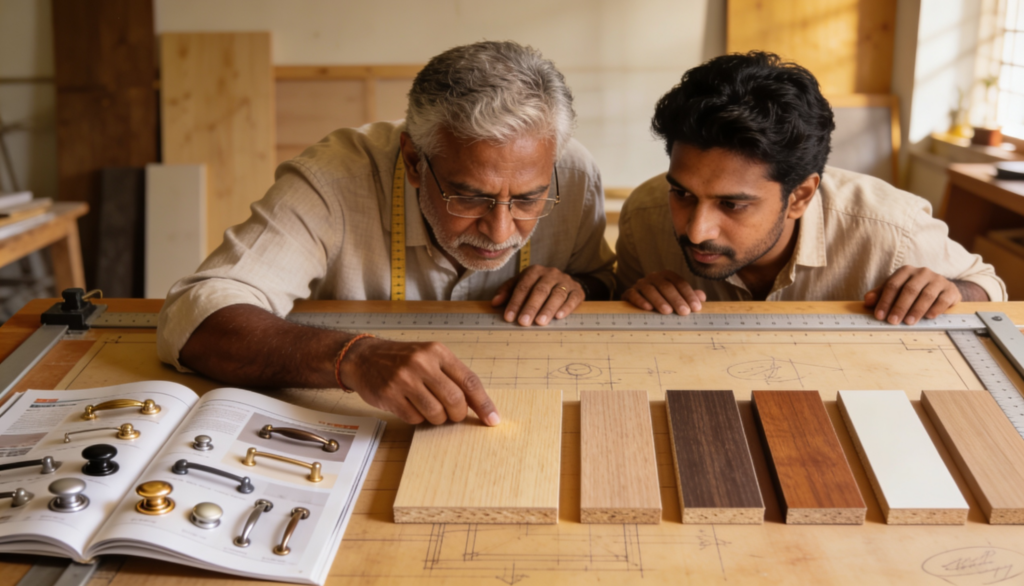
If you’re talking to a genuinely full-service firm, here’s what the process should look like – and what you should expect at each stage.
Stage 1: Initial Consultation
A good consultation isn’t a sales pitch. It’s a conversation about how you live. A great designer doesn’t walk into your home with a pre-formed idea. They ask questions first. What time do you wake up? Do you cook every day or once a week? Do you need a quiet study corner or a lively family room? Your routines shape your space, and a top designer knows that a beautiful room which disrupts your daily habits isn’t actually a good design. It’s just a good photograph.
Stage 2: Concept Development
Once the brief is locked, the design team works on spatial planning, mood boards, color palettes, material directions, and a rough cost structure. This stage defines the character of your home.
Stage 3: 3D Visualization and VR Previews
Most reputable firms now offer detailed 3D renders before execution begins. Premium firms take it further with VR walkthroughs, letting you literally “walk through” your space before a single nail is hammered. This is not a gimmick – it’s a genuinely useful tool for catching design decisions you might regret later.
Stage 4: Material Finalization and BOQ
The Bill of Quantities (BOQ) is the document that converts your design into a line-by-line cost. Every item – every panel, hinge, tile, and fixture – should be itemized here. If a firm skips this step or gives you a lump-sum quote without a BOQ, that’s a serious problem.
Stage 5: Execution
This is where the months of planning meet the reality of a construction site. A strong firm assigns a dedicated project manager, coordinates between fabricators, civil workers, electricians, and plumbers, and keeps you updated at meaningful intervals. At Line of Thought, this happens through a structured update system that keeps clients informed without overwhelming them with daily minutiae.
Stage 6: Handover
The handover stage should include a walkthrough, a snagging list (noting anything that needs correction), and documentation of all warranties – material, workmanship, and vendor-specific. Full home interiors in Bangalore typically take 90-150 days depending on scope; villa projects often run longer.
How to Evaluate an Interior Design Company’s Portfolio
A portfolio is not just a gallery of pretty pictures. If you know how to read one, it tells you almost everything you need to know about a firm.
Look for project diversity. A firm that has only delivered one type of apartment, in one style, for one kind of client is a firm that hasn’t been tested. You want to see projects across different home types, budgets, and design languages.
Study execution quality, not just renders. Any firm can generate beautiful 3D images. What matters is whether the finished project looks like those images. Ask specifically for “before and after” photos taken on-site, not studio-lit marketing shots.
Check for style range. A firm locked into a single aesthetic – all white and minimal, for instance – will struggle when your brief calls for warmth, texture, or cultural references. Some popular home interior styles in Bangalore are modern, contemporary, minimalist, and Scandinavian designs. Ethnic and rustic Indian designs have gained popularity among clients as well, an amalgamation of local culture and modern style.
Look for evidence of problem-solving. Ask what challenges came up in a specific project and how they were handled. A confident, experienced team will have real stories. A firm that presents only a flawless narrative has either never faced a problem or isn’t being honest with you.
Verify project scale. If you’re building a villa or undertaking a full renovation in Bangalore, you need to know the firm has handled comparable complexity. A team that has only done apartment interiors may not be ready for a ground-up construction project.
Red Flags When Vetting Interior Design Firms in Bangalore
You’re allowed to be a demanding client. In fact, you should be. Here are the warning signs that tell you to walk away.
Vague or verbal contracts. Your agreement should be a detailed written document covering scope, timeline, payment schedule, revision policy, warranty terms, and what happens in the event of a delay. If a firm says “we’ll handle it” without documentation, you have no protection.
No fixed timeline. Every project has dependencies – material lead times, site conditions, monsoon delays. A professional firm plans for these and still commits to a date range. “It depends” with no further structure is not an answer.
No dedicated project manager assigned. You should know exactly who is accountable for your project from start to finish. A contact person who is “the designer” part-time and “the PM” part-time is no one’s full attention.
No site visits in the brief. A firm that quotes without visiting your site is guessing. Site conditions in Bangalore vary significantly – ceiling heights, structural walls, utility lines, natural light availability – and none of that shows up in a floor plan.
No client references. Ask for two or three references from completed projects similar to yours. Any reputable firm will provide them without hesitation. If there’s resistance, that’s information.
Unusually low initial quotes. Hidden costs are one of the biggest reasons homeowners underestimate the interior designing cost in Bangalore. Most homeowners get shocked when the bill piles up. A quote that seems dramatically lower than competitors usually means items have been excluded that will re-appear as “extras” later.
Interior Design Pricing Models: Which Companies Are Transparent?
Understanding how a firm prices its work is critical before you sign anything. There are three main models in use across Bangalore’s interior design market.
Per Square Foot Model
This is the most common model. The average home interior cost in Bangalore ranges from Rs.1,500 to Rs.3,500 per sq. ft., depending on the quality of materials, design complexity, and finishes.
Here’s the breakdown by tier: – Basic interiors (Rs.1,200-Rs.1,800 per sq. ft.) are ideal for those working with a lower budget, offering functional yet stylish solutions. – Mid-range interiors (Rs.1,800-Rs.2,800 per sq. ft.) are the most popular choice for families seeking a balance of aesthetics and functionality. – Luxury interiors (Rs.3,000+ per sq. ft.) are high-end, fully customized, using premium finishes and imported materials.
When reading a per sq. ft. quote, always ask: What exactly is included in this rate? Some firms include only carpentry. Others include flooring, ceiling, electrical, and painting. The rate means nothing without knowing what it covers.
Percentage of Project Cost Model
Interior designers in Bangalore will charge a design fee ranging from 6% to 15% of the overall cost of the interior design of the house. This model works fine when the project scope is well-defined, but it can create a conflict of interest – a designer who earns more when the project costs more isn’t always incentivized to keep your budget lean.
Package Model
Fixed packages are common in the modular segment, covering a standard set of work for a fixed price. They’re predictable but inflexible. If your home has non-standard dimensions, specific requirements, or you want meaningful customization, a package may not serve you well.
The golden rule across all models: Ask for a detailed, itemized BOQ before you sign. A firm that resists this is not a firm you should trust with your home.
| Pricing Model | Best For | Watch Out For |
|---|---|---|
| Per sq. ft. | Most residential projects | Exclusions buried in fine print |
| % of project cost | Large, complex projects | Potential cost inflation |
| Fixed package | Modular, standard apartments | Poor fit for custom or complex spaces |
Questions to Ask an Interior Design Company Before Signing
Don’t walk into a design meeting without these. The answers will tell you more than any portfolio.
- Can I see the contract template before we discuss anything else?
- Who will be my dedicated point of contact throughout the project?
- How do you handle subcontractors – are they in-house or external?
- What is your policy if the project exceeds the agreed timeline?
- How many revisions are included in the design phase, and what happens if I need more?
- Can I visit a current project on-site to see your execution quality?
- Can I speak to two or three previous clients from projects similar in scope to mine?
- How is the payment schedule structured – and when exactly are payments due?
- What materials do you use for core carpentry (MDF, plywood grade, hardware brands)?
- Do you use BWR (Boiling Water Resistant) grade plywood for kitchens and wet areas?
- What happens if a material I’ve approved goes out of stock mid-project?
- What does your warranty cover, and for how long – materials, workmanship, or both?
- How do you communicate progress updates – phone calls, WhatsApp, a project dashboard?
- What is your process for handling client-raised concerns during execution?
- Have you worked on projects in this neighborhood, and are you familiar with BBMP or local authority requirements if applicable?
No firm should flinch at these questions. If they do, you’ve learned something important.
Bangalore-Specific Design Considerations Most Firms Won’t Mention
This is the section most competitors skip, and honestly, it’s one of the most practically useful things any guide on this topic can cover.
Bangalore’s climate demands material-aware design. The city’s humidity fluctuations across seasons – especially during the monsoon – affect how materials perform over time. Plywood grades matter. So do surface finishes, especially in kitchens and bathrooms. A firm that specifies the same materials regardless of room function or building orientation isn’t paying attention.
Space constraints in apartments are city-specific. Bangalore’s apartment stock, particularly in areas like Whitefield, Hebbal, and JP Nagar, often features layouts that don’t allow for conventional furniture placement. Good designers in this city understand how to handle narrow corridors, low-ceiling utility areas, and balconies that need to function as extensions of the living space.
Regulatory awareness matters for renovation in Bangalore. If your project involves structural changes or modifications to a villa or independent house, BBMP and BDA compliance is not optional. Line of Thought crafts intelligent, sustainable spaces for villas, apartments, and renovations across prime areas like Hebbal, Whitefield, and Bannerghatta Road, handling everything from curated interiors to full villa projects with real-time updates and regulatory compliance.
Natural light is a design variable, not a given. Bangalore’s dense urban pockets mean some apartments receive direct sunlight for only a few hours daily. A strong design team will account for this in lighting plans, mirror placement, and color selection rather than assuming you’ll fix it with overhead lighting.
What a Real Renovation in Bangalore Involves (And Why It’s Different from New Interiors)
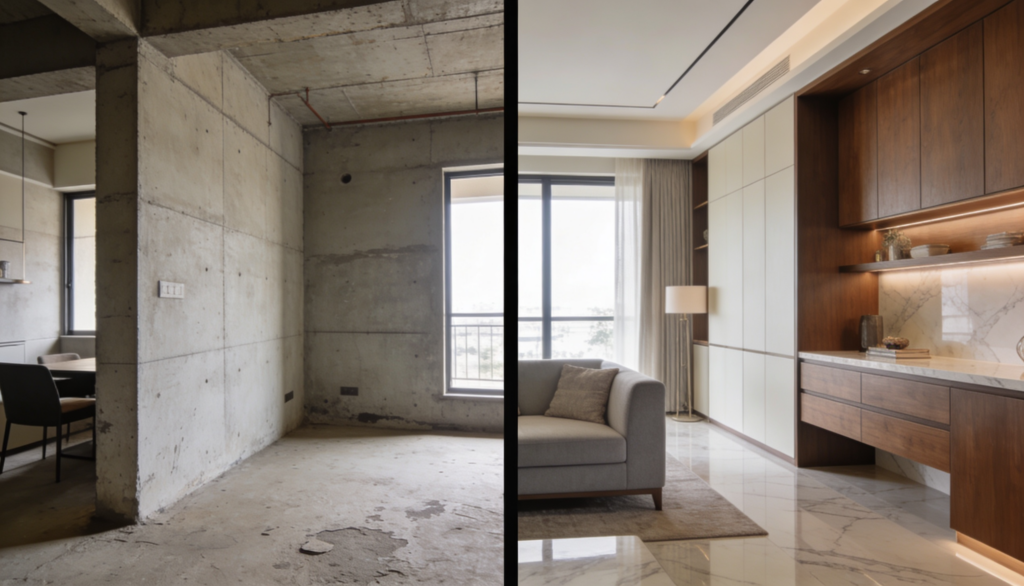
Renovation in Bangalore is a distinct category that deserves its own attention. A lot of homeowners approach it as a simpler version of a fresh interior project. It usually isn’t.
Renovation means working within an existing structure that may have outdated electrical wiring, plumbing that needs rerouting, concealed damp patches, or structural walls that can’t be modified. A design firm without construction expertise tends to underestimate these complications. A firm that operates as a construction company in Bangalore as well understands them before the first tile is broken.
Timelines for renovation also need realistic management. Depending on scope, a full home renovation can run anywhere from 45 days (cosmetic, surface-level) to 6+ months (structural changes, full replumb, rewire). Any firm quoting under 30 days for a comprehensive renovation is either planning to cut corners or hasn’t fully understood your brief.
Why Line of Thought Stands Out Among Interior Design Companies in Bangalore
There’s no shortage of firms in this city that will tell you what you want to hear during the sales conversation. What separates a genuinely capable firm from a well-marketed one usually shows up six weeks into execution.
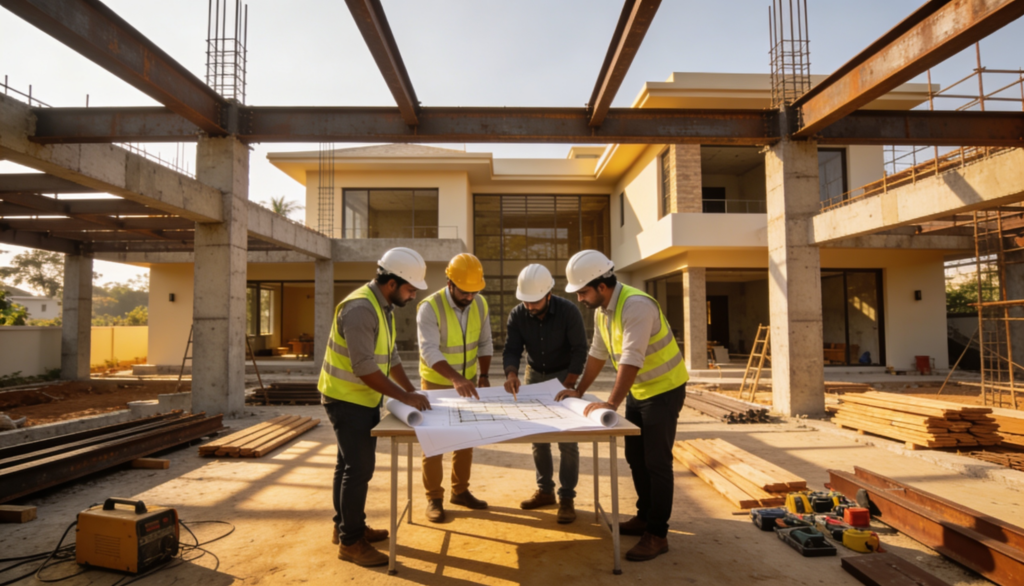
Because Line of Thought functions as both an interior designer in Bangalore and a construction company in Bangalore, the design team and construction team speak the same language – literally and professionally. A design decision is immediately evaluated for structural feasibility and cost implication. There are no surprises at the execution stage.
That integration is not a marketing line. It’s a structural advantage. When your designer and your builder are part of the same team, the conversation that would otherwise happen through email chains and missed calls instead happens in the same briefing room. Material choices get stress-tested against structural realities before they’re committed to. Design intent survives the transition to execution in a way it often doesn’t when those two functions are split across different parties.
Line of Thought’s work as a villa builder in Bangalore has given the firm a depth of experience that goes far beyond surface finishes. They understand site conditions, water table behavior, material behavior over time, and the regulatory landscape.
The firm’s offerings include:
- Full design-build integration – concept to construction to handover, under one accountable team
- VR previews – walk through your space before work begins
- Dedicated project management – one point of contact who actually knows the status of your project at any given moment
- WhatsApp-based progress updates – not a black box, not a monthly email, but real-time communication that fits how people actually live and work
- Premium material sourcing – vetted vendors, known material grades, no surprise substitutions
- Villa construction expertise – with full knowledge of what it takes to deliver a villa builder in Bangalore project from the ground up, not just the interior out
- Renovation in Bangalore – handling complex existing-structure projects with the structural awareness that comes from being a full construction firm
Line of Thought is a premier architecture and interiors studio in Bangalore, specializing in end-to-end design and build solutions for future-ready homes, crafting intelligent, sustainable spaces blending timeless aesthetics with eco-conscious materials and smart layouts.
Interior Design Costs in Bangalore: A Realistic 2026 Reference
This table is based on current market data from 2026. Treat these as planning benchmarks, not fixed quotes. Your actual costs will depend on material choices, design complexity, the firm you choose, and your location within Bangalore.
| Property Type | Basic / Functional | Mid-Range | Premium / Luxury |
|---|---|---|---|
| 1 BHK | Rs.2.5L – Rs.4L | Rs.4L – Rs.6L | Rs.6L – Rs.8L+ |
| 2 BHK | Rs.4L – Rs.8L | Rs.8L – Rs.12L | Rs.12L – Rs.15L+ |
| 3 BHK | Rs.7L – Rs.12L | Rs.12L – Rs.18L | Rs.18L – Rs.28L+ |
| 4 BHK / Villa | Rs.15L – Rs.20L | Rs.20L – Rs.30L | Rs.30L – Rs.60L+ |
A useful industry rule of thumb: allocate 10-15% of your property value for interiors. A Rs.80 lakh apartment should budget Rs.8-12 lakhs for quality interiors.
South Bangalore areas command 30-40% higher rates than emerging zones on the city’s outskirts, which is worth factoring into your planning if you’re in areas like Jayanagar, JP Nagar, or Koramangala.
Hidden Costs Homeowners Consistently Underestimate
Before you finalize any quote, make sure the following are explicitly covered or explicitly excluded:
- False ceiling work – False ceiling costs range from Rs.75-Rs.150 per sq. ft. for basic POP to Rs.200-Rs.350 for designer gypsum or wood finishes. It’s rarely included in base rates.
- Electrical changes – Rewiring, additional points, premium switches and fixtures add up.
- Modular kitchen – Modular kitchens range from Rs.1.5-Rs.5+ lakhs depending on size, materials, and appliances. Basic starts at Rs.1.5-Rs.2.5 lakhs; premium at Rs.4.5+ lakhs.
- Flooring – Flooring ranges from Rs.80-Rs.400 per sq. ft.: ceramic tiles at Rs.80-Rs.150, vitrified at Rs.100-Rs.200, marble at Rs.200-Rs.350, and granite at Rs.250-Rs.400.
- Wardrobes – Wardrobe interior costs in Bangalore range from Rs.60,000 to Rs.2 lakhs depending on material: laminate, acrylic, veneer, or glass.
- Designer fees – Often separate from execution costs in design-only and hybrid models.
Frequently Asked Questions: Interior Design Companies in Bangalore
Q1. How long does a full interior project take in Bangalore?
A standard apartment interior project in Bangalore – covering all rooms, modular kitchen, wardrobes, false ceiling, and finishes – typically takes 90 to 120 days from design approval to handover. More complex projects, partial renovation work, or homes with extensive customization can stretch to 150 days. Villa construction projects in Bangalore have longer timelines, often 12-24 months for a complete ground-up build. Any firm quoting under 45 days for a full home is either cutting scope or cutting corners.
Q2. What is included in a turnkey interior package?
A genuine turnkey package covers the full journey: initial consultation, concept design, 3D visualization, material selection and procurement, all civil and carpentry work, electrical and lighting, painting, furniture installation, and final handover with snagging. The key word is “all” – and you should verify exactly what’s excluded before signing. Some firms call themselves “turnkey” while excluding false ceilings, plumbing, or soft furnishings.
Q3. How do I know if an interior design company’s quote is fair?
Get at least two or three quotes from firms with comparable portfolios. Ask each for a detailed BOQ, not a summary number. Compare line by line – materials specified, hardware brands, plywood grades, hardware included. A lower headline number with inferior materials isn’t a better deal. It is best to confirm the details with the designer, as some simply provide woodwork and some do not include soft furnishings like curtains, blinds, and so forth.
Q4. What is the difference between an interior designer and an interior decorator?
An interior designer works on space planning, structural considerations, technical drawings, and often coordinates with architects and engineers. An interior decorator focuses on aesthetics – finishes, furniture, accessories, and styling. For a full home project, you need design capability, not just decorating sensibility. For a villa construction or renovation in Bangalore, you need a firm with construction expertise on top of that.
Q5. Should I hire a freelancer or a full-service interior design firm in Bangalore?
For small projects – a single room refresh, a rental apartment setup, or décor updates – a skilled freelancer can be a cost-effective choice. For complete home interiors, villa projects, or renovation in Bangalore that involves structural or civil work, a full-service firm with its own vendor network and project management is worth the additional investment. The risk of coordination failures with multiple independent parties tends to cost more in the long run than the premium a full-service firm charges.
Q6. What should I look for in a villa interior design firm in Bangalore?
Villa projects require a firm that understands both the design and construction dimensions of large-format residential spaces. Look for experience with high-ceiling rooms, large kitchen layouts, outdoor-indoor transitions, home theatre or media room execution, and premium material sourcing. The firm should also be comfortable navigating BBMP approvals and local regulatory requirements if any structural work is involved.
Q7. How do I avoid scope creep and budget overruns?
Three things protect you: a detailed BOQ signed before work begins, a contract with a clearly defined scope, and a payment schedule tied to milestones rather than calendar dates. Any significant design change after work begins will cost more – budget for a 10-15% contingency on any project. The industry rule of thumb is to allocate 10-15% of your property value for interior design. For an Rs.80 lakh apartment, budget Rs.8-12 lakhs for interiors.
Q8. What materials should I insist on for a kitchen interior?
For kitchen cabinets and carcase work, insist on BWR (Boiling Water Resistant) grade plywood – minimum 710 or Marine grade for areas near sinks and cooking zones. Avoid MDF for any moisture-exposed area. For shutters, marine plywood with good quality laminates or acrylic finishes hold up better than HDF options. Ask the firm to specify material grades in writing in the BOQ, not just in conversation.
Q9. Do interior design companies in Bangalore handle government approvals?
Design-only firms typically don’t. Full-service firms with in-house construction capability often assist with or manage approvals, particularly for renovation in Bangalore involving structural changes, or villa construction projects requiring BBMP plan sanctions. This is one of the less visible but genuinely important advantages of working with a firm like Line of Thought that operates as a construction company in Bangalore.
Q10. How do I evaluate an interior firm’s after-sales support and warranty?
Ask specifically: Is the warranty on materials, workmanship, or both? Who is responsible if a vendor warranty doesn’t cover a defect? What is the response time for snag resolution after handover? A reputable firm will have clear answers. The best firms show their work. That means shared timelines, written scopes of work, itemized cost breakdowns, and clear communication channels throughout. You should never be left guessing what phase your project is in or why there’s a delay. If a firm can’t explain their process clearly before the project starts, that opacity typically carries through to execution.
Key Takeaways
- Type of firm matters first. Identify whether you need design-only, turnkey, or a full design-build partner before comparing any names or prices.
- The full-service process has six stages. Consultation, concept, visualization, BOQ finalization, execution, and handover. Firms that skip or rush any of these create problems downstream.
- Pricing ranges from Rs.1,200 to Rs.4,500+ per sq. ft. in Bangalore in 2026. South Bangalore commands a 30-40% premium. Always get a line-item BOQ.
- Red flags are non-negotiable dealbreakers. No site visit, no written contract, no PM assigned, no client references – any one of these should end the conversation.
- Ask all 15 questions before signing. Material grades, subcontractor policy, revision limits, payment milestones, and warranty coverage are your protection.
- Bangalore-specific factors matter. Climate, space constraints, regulatory requirements, and light conditions all affect how a design should be approached – and how materials should be chosen.
- Renovation is not simplified new construction. It requires structural awareness. A design-only firm is rarely the right choice for complex renovation in Bangalore.
- Line of Thought’s design-build integration eliminates the gap that causes most project failures in this city: designers and builders who don’t communicate with each other.
- VR previews before execution let you validate design decisions before money is spent on fabrication.
- Budget 10-15% contingency on any project. Hidden costs around false ceilings, electrical, and finishes are common and predictable if you plan ahead.
Ready to talk through your project? Line of Thought works with homeowners, villa owners, and property developers across Bangalore on interior design, villa construction, renovation, and full design-build projects. Visit thelineofthought.com to explore the portfolio or schedule a consultation.