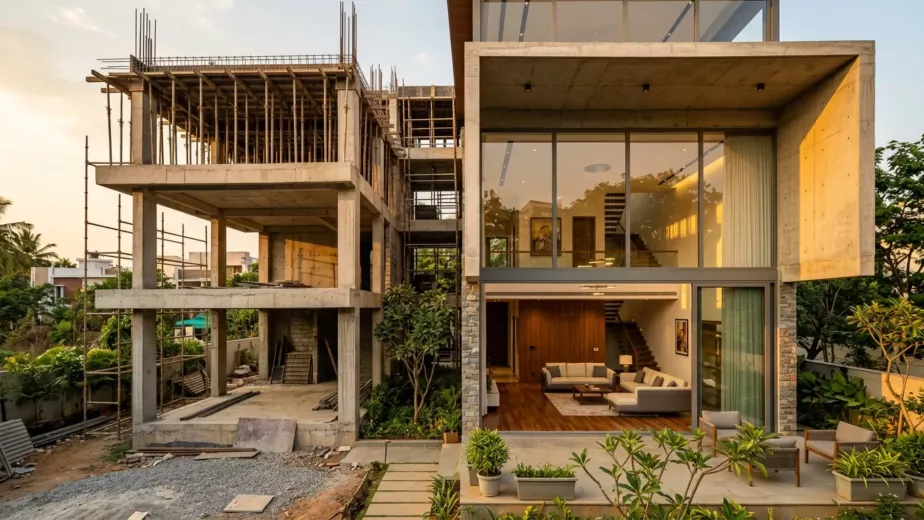

Most “top construction companies in Bangalore” lists are either sponsored posts or search-ranking exercises that have nothing to do with how well a company actually builds. Genuine quality in construction comes down to verifiable, process-driven criteria – things like RERA compliance, in-house engineering, itemized cost transparency, and post-handover accountability. This guide gives you a practical framework to evaluate any construction company in Bangalore the right way, before you sign anything.
TL;DR
- Most online rankings of construction companies in Bangalore are paid lists or SEO-driven content, not quality assessments.
- The 10 criteria in this guide cover legal compliance, portfolio verification, structural engineering, cost transparency, project management, quality control, technology use, sustainability, client references, and post-handover support.
- A vague per-sq-ft quote with no material specs is a red flag – every serious builder gives you a detailed Bill of Quantities.
- You should be able to visit a past completed project, not just see renders.
- Post-handover warranty and a named after-sales contact are non-negotiable marks of a trustworthy firm.
- Line of Thought meets all 10 criteria outlined here, backed by completed residential and villa projects across Bangalore.
Why “Top Construction Companies in Bangalore” Rankings Are Often Unreliable
Here’s something most people don’t talk about openly: a significant portion of “top 10 construction companies in Bangalore” articles you find online are either sponsored content or written purely to rank on Google, with zero independent verification behind them.
Bangalore saw a 10-year high annual sales growth in 2024, and with that sustained housing demand, the market has attracted a surge of new players all competing for the same clients. That competition has spilled into digital marketing, and frankly, it’s made it harder than ever to separate legitimate firms from those with a good content strategy.
Here’s what actually happens with most of these lists: a company pays for inclusion, gets featured in a round-up, and suddenly has “award-winning” in its bio. Or a firm does good SEO and ranks highly, which gets mistaken for credibility. Neither has anything to do with whether the concrete they pour meets IS standards, whether their structural drawings are stamped by a licensed engineer, or whether their clients would actually take a call from you about their experience.
Bangalore saw 71,000 to 73,000 new residential launches in 2025 alone – a 31 to 35% increase from the previous year. With that kind of volume entering the market, the pressure to cut corners quietly has never been higher.
So rather than give you another list you can’t verify, this post gives you a framework. Ten specific criteria you can use to evaluate any construction company – or villa builder – in Bangalore on your own terms. These are the same criteria we apply to ourselves at Line of Thought, and we’re confident enough in our track record to put them in writing.
What “Genuine Quality” Actually Means in Construction
Before getting into the criteria, it’s worth being clear about what quality means in construction, because it’s not what most marketing materials say it is.
Quality in construction is not a premium material upgrade or an architect’s sketch that looks good in a brochure. It’s a system. It’s what happens at every stage between breaking ground and handing over keys – the testing, the inspections, the paper trail, the people making daily decisions on site.
Quality assurance in construction is about establishing clear guidelines for minimum standards at every stage, so that every decision made on site has a consistent framework behind it. That includes material selection, structural execution, waterproofing, finishing, and even how defects are logged and fixed.
India’s residential construction market was valued at USD 263.89 billion in 2025. A market that size has firms of every quality level competing for your project. The criteria below help you tell them apart.
Criterion 1: RERA Registration and Statutory Compliance
This is the starting point, not the finish line.
RERA, or the Real Estate (Regulation and Development) Act, 2016, is a law designed to regulate the real estate sector and ensure transparency, accountability, and protection for homebuyers. For any construction project above a certain threshold in Bangalore, RERA registration with Karnataka’s state authority is mandatory.
RERA ensures timely delivery of construction projects and builders will be fined if they do not deliver on time. It increases authenticity and makes homebuyers trust the builder, developer, and broker.
Here’s what you should actually check beyond just the RERA number:
BBMP Contractor Registration:
Is the firm registered as a contractor with the Bruhat Bengaluru Mahanagara Palike? This matters for municipal approvals, particularly for residential construction within BBMP limits.
Licensed Architect on Payroll or Retainer:
The design drawings submitted for building plan approval must be signed by a Council of Architecture-registered architect. Ask to see the COA registration number.
Structural Engineer Involvement:
A licensed structural engineer should have prepared and signed the structural drawings. This is not optional in responsible construction – it’s the foundation of everything that follows.
How to verify:
Visit rera.karnataka.gov.in, go to the Project Status section, and search using the company or project name. You can verify project details on the official Karnataka RERA portal by searching for the project name and registration number to check approved status, builder information, and timeline.
A firm that hesitates to share its RERA number, contractor registration, or professional credentials is telling you something important.
Criterion 2: A Verifiable Portfolio of Completed Residential Projects
Renders are not a portfolio. CAD walkthroughs are not a portfolio. A completed building you can walk through, touch the walls of, and speak to the residents about – that’s a portfolio.
This matters more than most clients realize until it’s too late. A firm might have gorgeous 3D visuals of projects that are either still under construction, significantly different from what was shown, or in one notable case we’ve heard of, someone else’s completed project entirely.
Here’s exactly how to request a site visit to a past project:
- Ask the firm for two or three completed residential projects from the last three years.
- Request the physical addresses, not just project names.
- Ask for permission to visit the exterior and, ideally, speak with the homeowner.
- While on site, look at the finishing quality: tile alignment, plaster smoothness, external waterproofing at parapets and window sills, compound wall construction, and drainage slope.
- If the firm is reluctant to facilitate a site visit, treat that as a significant red flag.
A confident, established construction company in Bangalore has no reason to withhold this. We regularly offer site visits at Line of Thought because our completed projects say more about us than any brochure could.
Criterion 3: In-House Structural Engineering Team

This criterion separates genuinely capable firms from coordinators who outsource everything and hope for the best.
When a construction company has a structural engineer in-house or on permanent retainer, several things change:
- Structural drawings are produced with a direct understanding of the project’s specific conditions: soil type, load requirements, site constraints.
- Any deviation during construction – which happens on every project – gets addressed by someone who understands the original intent, not just the dimensions on paper.
- Post-handover defects are significantly reduced because the engineering decisions were made carefully and tracked throughout execution.
The firms that rely entirely on subcontracted engineering tend to produce buildings that look fine at handover but reveal problems at 18 to 36 months. Water seepage from structural cracks, uneven settlement, staircase joint failures – these are not cosmetic issues. They’re engineering failures.
In-house engineering isn’t just a quality marker. It’s also a liability marker. A firm with its own engineer has skin in the game structurally, not just commercially.
At Line of Thought, structural oversight is integrated into every residential and villa construction project from the foundation stage, not added as an afterthought.
Criterion 4: Transparent, Itemized Bill of Quantities

If a construction company quotes you a round number per square foot without specifying what materials that covers, you do not have a quote. You have a placeholder.
A genuine Bill of Quantities – or BOQ – is a line-by-line breakdown of every material and activity that goes into constructing your home. A proper BOQ should include:
- Concrete grade for each structural element (M20, M25, M30)
- Steel specification (Fe 500D or higher for seismic zones)
- Cement brand and grade
- Brick type and manufacturer
- Plumbing brand and pipe specification (CPVC vs UPVC, etc.)
- Electrical wiring brand and wire gauge
- Waterproofing membrane brand and number of coats
- Flooring material, thickness, and finish grade
- Door and window frame material and glass specification
When materials are named, two things happen: the client knows what they’re getting, and the contractor is contractually bound to deliver it. When materials are vague, the contractor has the freedom to substitute downward at every stage without technically violating the contract.
Ask any company you’re evaluating for a sample BOQ from a past project (with client details removed). If they don’t have one ready, or if the one they show you is a single-page document, walk away.
Criterion 5: Dedicated Project Manager for Every Site
Construction projects go wrong for one reason more than any other: nobody is clearly in charge on a day-to-day basis.
A dedicated project manager is not the company director who visits once a fortnight. It’s a named individual who:
- Is present on site at key stages every day
- Manages the labour schedule and subcontractor coordination
- Approves material deliveries against the approved BOQ
- Documents daily progress and flags deviations
- Is reachable by phone during working hours
Before you sign a contract with any construction firm, ask these specific questions:
- Who will be the dedicated project manager for my site?
- Can I meet them before signing?
- How many other sites are they managing simultaneously?
- What is their escalation process when something goes wrong?
A single project manager handling more than three or four active sites simultaneously is stretched thin. That’s not a judgment on the individual – it’s a structural management problem that usually shows up in quality and timeline.
At Line of Thought, every construction and renovation project has a named project manager from day one, and clients have direct contact details, not just a general office number.
Criterion 6: Quality Control Protocols at Every Stage
Quality in construction is not inspected at the end. It has to be built in at every stage.
A quality-focused construction company in Bangalore runs structured checks at each of the following stages:
Foundation and Substructure:
- Soil test report reviewed before PCC (Plain Cement Concrete)
- Rebar diameter and spacing verified against structural drawings before pouring
- Concrete slump test conducted on every pour to ensure workability and water-cement ratio compliance
Superstructure (Columns, Beams, Slabs):
- Cube test samples collected for each pour and sent for 28-day compressive strength testing
- Column and beam shuttering checked for alignment before casting
- Slab thickness verified at multiple points after casting
Brick and Block Work:
- Mortar mix ratio checked
- Plumb and level verified course by course
Waterproofing:
- Application in sunken slabs, terraces, and external walls inspected before tile or finishing work covers it
- Flood test or water retention test on terraces before handover
Finishing:
- Plaster thickness and surface finish checked before paint
- Tile alignment, grout consistency, and lippage checked room by room
- Electrical and plumbing pressure tests conducted before walls are closed
Ask any company you’re evaluating whether these protocols exist in documented form. If they do, ask to see the checklist template. A firm that cannot show you a quality control document trail is likely running on instinct, not process.
Criterion 7: Technology-Enabled Project Tracking
The days of “I’ll call you when there’s news” should be behind us. Modern construction project management gives clients visibility at every stage without requiring them to be on site.
What technology-enabled tracking looks like in practice:
- A shared project dashboard (whether a purpose-built app or a structured shared folder) where milestone completion is logged with dates and photos
- Time-stamped site photography at key stages – before concrete is poured, after rebar placement, at each floor completion
- Digital material delivery logs that match against the approved BOQ
- Digital change order approvals – any scope change above a threshold requires documented client sign-off before work proceeds
- Regular progress reports on a fixed schedule, not when the firm feels like it
This level of transparency protects the client. It also protects the contractor, because disputes about what was approved become traceable.
Technologies like modular construction and digital project management are accelerating project timelines and improving cost efficiency across Bangalore’s residential construction sector. Firms that haven’t adopted these tools yet are falling behind clients’ expectations as much as they’re falling behind competitors.
Criterion 8: Sustainable Building Practices
Sustainable construction is not a marketing badge. It’s a set of practices that affect the structural longevity, running costs, and indoor environment quality of your home for the next 30 to 50 years.
There’s a clear shift among buyers towards eco-conscious, smart homes that offer energy efficiency, green building certifications, solar integration, and intelligent home automation. The construction companies that have adapted to this shift are producing better-quality buildings in every measurable sense, not just greener ones.
What to look for in a construction company’s sustainability approach:
Material Choices:
- Use of fly ash bricks or AAC blocks instead of conventional red brick (better thermal performance, lower embodied carbon)
- Recyclable steel with verified IS certification
- Low-VOC paints and adhesives for better indoor air quality
Construction Waste Management:
- Is demolition and construction debris sorted and disposed of responsibly, or does it go to the nearest empty plot?
- Is excess concrete mixed properly rather than dumped?
Energy-Efficient Design:
- Passive design principles: orientation, window placement, shading, and ventilation built into the design before systems are added
- Solar-ready wiring provision during construction (far cheaper than retrofitting later)
- Rainwater harvesting integration during construction (mandatory under BBMP and BWSSB rules for sites above 2,400 sq ft)
Water Efficiency:
- Dual-plumbing provision for recycled water
- Low-flow fixture specifications
A construction company that has no answer when you ask about sustainable practices is one that hasn’t thought seriously about the quality of what they build.
Criterion 9: Client References You Can Actually Speak To
This is the one criterion that almost no company’s website tells you how to test, and almost no client knows to ask for.
There is a significant difference between a written testimonial on a website and a real homeowner who will take a 15-minute phone call with you.
Written testimonials are selected, edited, and sometimes fabricated. A real client conversation tells you things you’d never get from marketing material – how the firm handled a delay, how they responded to a defect discovered after handover, whether the final cost matched the quoted cost, and whether the project manager was actually reachable.
Here’s how to ask for genuine client references:
- Request three client references from completed projects in the past two years.
- Ask for the clients’ direct phone numbers, not a general office contact.
- Prepare specific questions: Did the project finish on time? Were there cost escalations? How was the firm’s response to post-handover issues? Would you hire them again?
- If the firm offers only email references or “we’ll pass your number along,” push back. A genuinely confident company connects you directly.
At Line of Thought, we actively encourage prospective clients to speak with past homeowners. It’s one of the most honest things we can offer.
Criterion 10: Post-Handover Warranty and Maintenance Support
Handover is not the end of a construction company’s responsibility. In responsible construction practice, it’s the beginning of a warranty period that covers you when real-world conditions reveal what quality inspections sometimes miss.
Here’s what you should ask for in writing before signing any construction contract:
Structural Warranty:
A minimum 10-year warranty on structural defects, covering anything that affects the building’s load-bearing integrity. This is a standard expectation for any serious firm.
Waterproofing Warranty:
Minimum 5 years on all waterproofed surfaces, including terraces, sunken slabs, and external walls.
Defect Liability Period (DLP):
A 12 to 24-month defect liability period post-handover, during which any defect that surfaces in normal use conditions is the contractor’s responsibility to fix at no additional cost.
Named After-Sales Contact:
Who do you call when something goes wrong at month 18? “Contact our general office number” is not a good enough answer. A responsible firm gives you a named individual.
Emergency Response:
For issues like water ingress or structural cracking, what is the response time? Get this in writing.
Villas and landed houses are forecast to expand at a 6.97% CAGR through 2031, and renovation is growing at a 7.05% CAGR. With that much construction activity coming, post-handover accountability is becoming a key differentiator between firms – and clients are getting better at asking for it upfront.
A Section Most Blogs Skip: Red Flags to Watch Before You Sign
Most guides tell you what good looks like. Fewer tell you what trouble looks like early, when you can still walk away. Here’s what should genuinely concern you:
Vague or Verbal-Only Agreements:
Any construction company that resists putting the full scope, material specifications, payment schedule, and warranty terms in a written contract is not a company you should build with.
No Fixed Price or Cost Escalation Clause:
“We’ll charge actuals” is a phrase that has cost Bangalore homeowners lakhs. A responsible contractor gives you a fixed-price contract with clearly defined conditions under which the price can change (and limits on that change).
Pressure to Pay Large Advances:
A legitimate firm doesn’t need 40% upfront before the foundation is dug. Milestone-based payment schedules are standard practice.
No Clear Site Management:
If you visit the site and nobody can tell you who the project manager is or where they are, that’s a management structure problem, not a timing coincidence.
Subcontracting Everything:
There’s nothing wrong with specialist subcontractors. But if the firm you’re hiring is essentially a coordinator with no in-house capability, you’re paying a premium for very little value-add.
Reluctance to Share Past Client Contacts:
Covered in Criterion 9, but worth repeating – a firm that cannot connect you with satisfied past clients likely doesn’t have many.
How Line of Thought Meets All 10 Criteria

Line of Thought is a premium construction company in Bangalore, operating across residential construction, villa construction, interior design, and renovation projects. Here’s an honest breakdown against each criterion:
1. RERA Registration and Statutory Compliance
Line of Thought operates with full statutory compliance on all applicable projects, with licensed architects and structural engineers engaged on every residential build. Our credentials are available for any prospective client to verify.
2. Verifiable Portfolio of Completed Residential Projects
We have a portfolio of completed homes and villas across Bangalore that clients can visit. We don’t lead with renders – we lead with addresses. Prospective clients are welcome to request a site visit through our website at thelineofthought.com.
3. In-House Structural Engineering Team
Every construction and villa build project at Line of Thought involves structural engineering oversight from the foundation stage through handover. Engineering decisions aren’t delegated to whoever is available – they’re owned by people accountable to the outcome.
4. Transparent, Itemized Bill of Quantities
Our contracts don’t have single-line “per sq ft” pricing. Every project quotation is broken down by material, activity, and stage – so clients know exactly what they’re buying and can hold us to it.
5. Dedicated Project Manager for Every Site
Every Line of Thought project has a named project manager. You’ll meet them before construction begins, and their number is in your phone before the first brick is laid.
6. Quality Control Protocols at Every Stage
From slump tests at foundation pour to tile lippage checks at handover, quality control at Line of Thought is documented, not assumed. We can walk any client through our stage-by-stage inspection protocol.
7. Technology-Enabled Project Tracking
Clients receive regular milestone updates with site photography, and change orders are documented and approved digitally. We believe visibility isn’t optional – it’s how trust is built over a 12 to 18-month construction timeline.
8. Sustainable Building Practices
Line of Thought integrates sustainable material choices, energy-efficient design principles, and responsible waste management into every new build. This is part of our design philosophy, not an optional add-on.
9. Client References You Can Actually Speak To
We’re confident enough in our client relationships to connect prospective clients directly. Ask us for references on a call, and we’ll provide them.
10. Post-Handover Warranty and Maintenance Support
Our contracts include structural warranties, a defined defect liability period, and a named after-sales contact. We don’t disappear at handover.
If you’re researching construction companies in Bangalore, we’d welcome a conversation. You can explore our work and reach us through thelineofthought.com.
The Hidden Cost of Getting This Wrong
People often calculate the cost of hiring a bad construction company as the difference between the quoted price and the final invoice. The real number is usually much larger.
Structural repairs on a completed building cost 3 to 5 times more than getting it right the first time. Waterproofing failures in a completed home require gutting the affected area, redoing the membrane, replacing the finish, and living with disruption for weeks or months. A foundation defect in a villa is not a minor inconvenience – it’s a structural crisis.
Property prices in Bangalore rose 12% year-on-year in H2 2024 according to Knight Frank’s Real Estate Report. When you’re investing in an asset at these price points, the cost of verifying your contractor against every criterion in this guide is genuinely close to zero compared to the risk of getting it wrong.
FAQs: Top Construction Companies in Bangalore
Q1. How do I verify if a construction company in Bangalore is genuinely registered and compliant?
Start with the Karnataka RERA portal at rera.karnataka.gov.in. Search for the company or project name to confirm registration status, approved timeline, and any complaints on record. Beyond RERA, ask for BBMP contractor registration, a Council of Architecture-registered architect’s COA number, and the structural engineer’s credentials. Any firm reluctant to share these is not operating with full transparency.
Q2. What is a Bill of Quantities and why does it matter when hiring a builder in Bangalore?
A Bill of Quantities (BOQ) is a detailed, line-by-line breakdown of every material, activity, and specification in your construction project. It matters because it binds the contractor to specific materials and prevents them from substituting cheaper alternatives mid-project. A BOQ also gives you a basis for comparing quotes from different firms – you’re comparing like for like rather than guessing what each firm’s “per sq ft” rate actually covers.
Q3. What should I check when visiting a construction company’s completed project?
Look at external waterproofing at parapets, window sills, and water downpipes. Check internal tile alignment and grout quality. Examine plaster smoothness under a light held at a flat angle. Look at the compound wall, drainage slope, and any visible structural joints. Ask the homeowner directly: Did the cost match the quote? Were there post-handover issues? How quickly did the firm respond?
Q4. How many active sites should a project manager be handling at once?
A project manager handling more than three to four active residential construction sites simultaneously is typically stretched beyond effective oversight. This doesn’t mean a firm with many projects is bad – it means they need enough project managers to maintain the ratio. Ask specifically how many sites your named project manager will be running when your project begins.
Q5. Is RERA registration mandatory for all construction companies in Bangalore?
RERA registration is mandatory for real estate projects with more than eight apartments or a plot area exceeding 500 sq metres. For individual residential construction (building on your own plot), RERA may not directly apply to the contractor – but BBMP building plan approval, licensed architect certification, and structural engineer sign-off remain mandatory regardless.
Q6. What is a defect liability period and how long should it be?
A defect liability period (DLP) is the timeframe after handover during which the contractor is responsible for fixing defects that arise under normal use conditions at no additional cost to the client. For residential construction in Bangalore, a responsible DLP is 12 to 24 months. Structural warranties should extend beyond this – a minimum of 5 to 10 years for load-bearing elements is reasonable to ask for in writing.
Q7. What does a sustainable construction approach actually involve in a Bangalore home build?
Sustainable construction in Bangalore involves choices at every stage: using AAC or fly ash blocks instead of conventional bricks for better thermal performance, specifying IS-certified steel, using low-VOC finishes, designing for passive ventilation and shading, installing rainwater harvesting (mandatory for sites above 2,400 sq ft under BWSSB rules), and including solar-ready wiring provision during construction. These decisions affect your home’s comfort and running costs for decades.
Q8. How should a construction company in Bangalore handle cost escalation during a project?
A responsible contractor agrees on a fixed-price contract with clearly defined escalation clauses. Acceptable escalation triggers include material price increases above a documented index threshold (typically tied to wholesale price indices for steel and cement), or scope changes initiated by the client. Random escalation demands mid-project with no contractual basis are a red flag. Any change to the agreed scope should require written client approval before work proceeds.
Q9. What is the difference between a villa builder in Bangalore and a general construction contractor?
A villa builder in Bangalore typically specializes in standalone residential construction with a higher level of design integration, material specification, and client customization compared to a volume contractor. The best villa builders work with in-house architects and engineers, manage custom material procurement, handle interior coordination, and deliver a turnkey finished home. A general contractor may be adequate for standard construction but may lack the design sensibility and specification depth that villa construction requires.
Q10. What questions should I ask before signing a construction contract in Bangalore?
Ask these ten questions before signing anything: Who is my named project manager, and how many sites do they handle? Can I have a full itemized BOQ before the contract is finalized? Can you provide addresses of two completed projects I can visit? What are the exact materials specified for structure, waterproofing, and finishes? What is your payment schedule and what triggers each milestone payment? How will scope changes be documented and priced? What is your defect liability period? Who is my named after-sales contact post-handover? Can you provide references of past clients I can call? What happens if the project exceeds the agreed completion date?
Key Takeaways
- Most rankings are unreliable. Online “top construction companies in Bangalore” lists are frequently sponsored or SEO-driven, not quality-verified.
- RERA is the floor, not the ceiling. Statutory compliance is a minimum requirement, not a quality differentiator on its own.
- A real portfolio has real addresses. Any company worth hiring can give you a completed project you can visit.
- In-house engineering reduces post-handover defects. Structural oversight by dedicated engineers during construction prevents the most expensive problems.
- Vague quotes are not quotes. A proper BOQ names every material and specification. Anything less gives the contractor too much flexibility to substitute downward.
- One named project manager per site matters. Diffused responsibility is how timelines slip and quality drops.
- Quality control is documented, not assumed. Concrete tests, waterproofing inspections, tile checks – these should exist on paper, not just as verbal assurances.
- Sustainability is a structural quality marker, not just an ethical one. The right materials and design choices extend your home’s lifespan and reduce running costs.
- Written testimonials don’t replace a phone call. Ask for real client references you can speak to before signing.
- Post-handover warranty belongs in the contract. Structural warranty, defect liability period, and a named after-sales contact should all be in writing before you hand over a rupee.
- Bangalore property prices rose 12% year-on-year in H2 2024, making the stakes of choosing the right construction partner higher than ever.
- Line of Thought, a premium construction company in Bangalore, villa builder in Bangalore, interior designer in Bangalore, and leader in renovation in Bangalore, meets all 10 criteria outlined here. You can explore our work at thelineofthought.com.