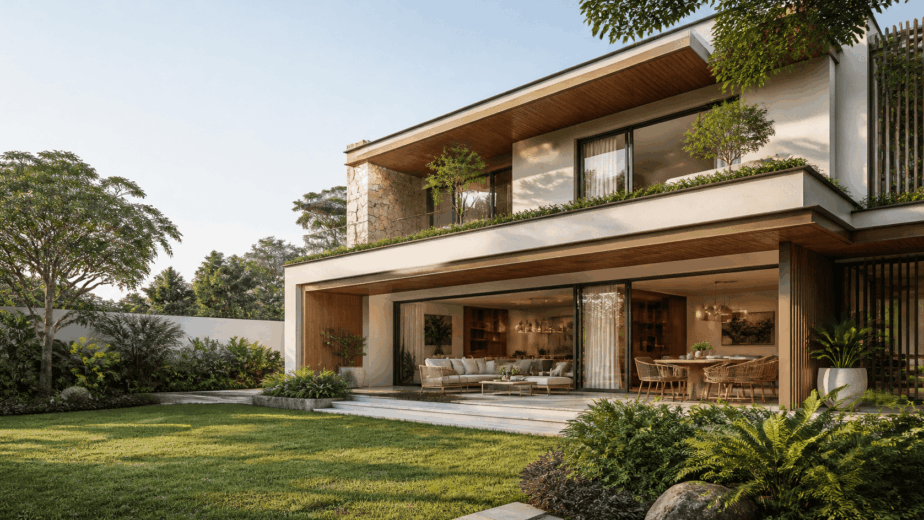
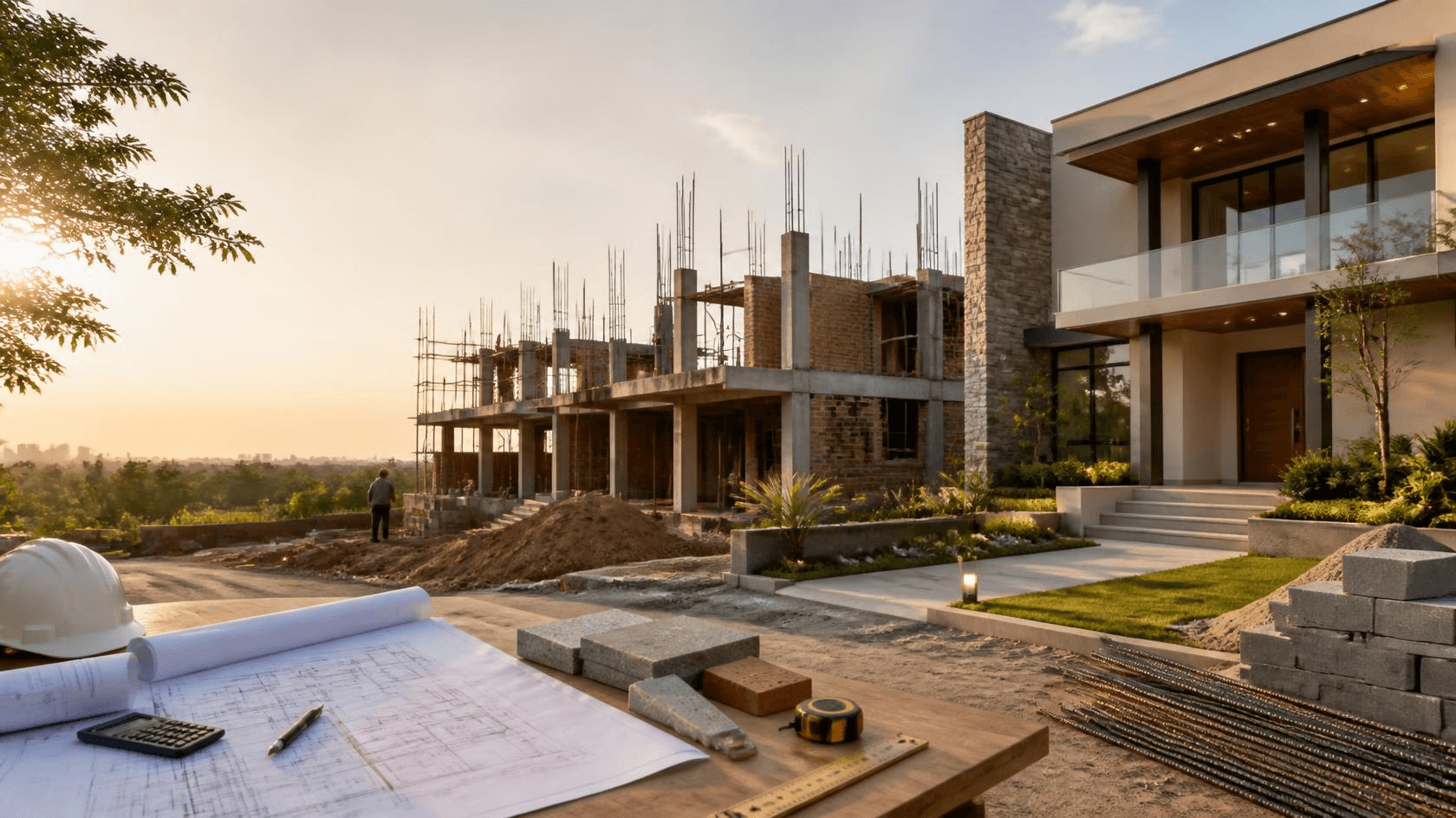
Bangalore’s villa market has changed a lot over the past few years. More families are choosing homes with private gardens over high-rise apartments. Many of them are building on land they already own in areas like Sarjapur, Devanahalli, Whitefield and Kanakapura Road. Most people ask the same question: how much will it really cost?
At Line of Thought, we help homeowners plan and build villas across Bangalore. That’s why we’ve put together this guide to explain the villa construction cost in Bangalore for 2026. It covers per-foot rates, where the money goes, common surprises and how to pick the right villa construction company.
Villa Cost in Bangalore: The Quick Answer
The cost to build a villa in Bangalore in 2026 is around ₹3,000 per sq ft for a standard turnkey project, not including land. Most projects range from ₹2,200 to ₹5,000 or more per sq ft depending on the design and materials. Keep in mind no single number is a price. The plot size, design and finishes all affect the final cost. Think of any figure as a starting point, not a quote.
| Villa category | Approx. construction cost per sq ft | What you typically get |
| Basic | ₹2,200 – ₹2,700 | Simple layout, standard tiles, basic fittings |
| Standard | ₹2,700 – ₹3,400 | Vitrified flooring, branded fixtures, decent woodwork |
| Premium | ₹3,400 – ₹4,800 | Custom elevation, modular kitchen, better sanitaryware and lighting |
| Luxury | ₹4,800 and above | Imported finishes, automation, bespoke design, landscaping |
When you are looking at the price of a ready-built villa in a gated community in Bangalore, the figures will be considerably higher since the cost includes the land, the amenities and the developer’s profit. The article in question is about constructing your own villa on your own piece of land.
Understanding Construction Cost Per Square Feet
Builders give the cost of construction per square foot based on the built-up area rather than the plot size. The built-up area comprises all the floors, the balconies, the staircases and usually also the sump and the parking spaces.
A plot that is 40 by 60 feet has an area of 2,400 square feet, but a ground-plus-one villa situated on it can have a built-up area ranging from 3,500 to 4,000 square feet. It is at this point that a great many budget errors start to occur. You should ask any builder to clarify how the area is measured, what is included in the rate, and what is charged separately.
You should also be careful about an extremely low rate since a rate that seems attractive usually omits information about the steel grade of the structure, the flooring allowance, or the plumbing and electrical fittings, these are then added later as ‘extras’.
Where Your Villa Budget Actually Goes
The knowledge of the division allows you to determine where to spend and where to save. Typical proportions for a mid-range villa are:
- The foundation and structural elements (30–35%) include excavation, footings, columns, beams, slabs and steel; this aspect is one that you must never compromise on.
- Masonry and plastering (10–12 per cent): this includes both internal and external plastering as well as block or brick work.
- The proportion allocated to flooring and tiling (10–12%) is the most variable. Vitrified tiles and Italian marble are at the two ends of the budget.
- The plumbing and electrical work (10–12%) includes the hidden piping, wiring, switches, fixtures and the arrangement of the water supply.
- Doors, windows and woodworking (8–10%): teak or engineered wood, UPVC or aluminium windows, wardrobes.
- Painting (5–6%): involves the use of putty, primer, emulsion and exterior weatherproof coats.
- The cost of waterproofing, roofing and terraces is small but becomes expensive to remedy if it fails.
- The design, the necessary approvals and supervision (4 to 6 per cent): the architect, the structural engineer and the sanction fees.
- The external features (3–5%) include a compound wall, a gate, a driveway and some basic landscaping.
Key Factors That Push Villa Construction Cost Up or Down
Location
While construction rates do not rise or fall as dramatically according to area as land prices do, location is still important; plots situated in widely dispersed layouts may result in higher transport costs for materials and slower access for labour. In areas with narrow roads where a concrete mixer cannot go, handling costs will increase. Moreover, established localities may involve stricter supervision and more expensive labour.
Design and Complexity
A rectangular two-storey villa is cheaper to construct than one which has a double-height living room, cantilevered balconies, curved walls and a stepped elevation since each additional corner, projection and custom feature requires more shuttering, more steel and more skilled labour.
Material Choices
Changing from standard to premium tiles in a villa of 3,000 square feet will alone increase the cost by several lakhs; the same applies to sanitaryware, kitchen fittings and window systems. Decide on your ‘non-negotiables’ at an early stage and assign a fixed budget to each category.
Plot Shape and Soil
Plots that are irregular in shape or sloping will require extra digging, retaining walls and, in some cases, deeper foundations. The type of soil is also a factor. Although the soil in Bangalore is generally favourable, it is a cheap form of insurance to carry out a soil test before carrying out the design, especially when the land is near a lake or is filled with land.
Example: What Would a 30×40 Villa Cost?
A plot measuring 30 by 40 is 1,200 square feet, which is one of the most common plot sizes in Bangalore. The following shows how it could work at the usual rates of about ₹2,500 to ₹3,200 per square foot:
- The ground floor only (with a built-up area of about 1,000 to 1,100 sq ft) costs around ₹27 to ₹35 lakhs.
- The ground floor together with the first floor (approximately 2,000 to 2,200 sq ft) costs about ₹50 to ₹70 lakhs.
- The ground floor together with two floors (about 3,000 to 3,300 sq ft) costs about ₹75 to ₹1.05 crore.
Premium specifications can raise each of these figures by 25 to 40 per cent, and you should then add 10 to 15 per cent more for contingencies and the additional items discussed below.
Inclusions, Exclusions and Hidden Costs
Even a well-planned budget can slip if you ignore the costs that sit outside the per-sq-ft rate:
- The approvals and fees include the plan sanction, the connections with the utilities (BESCOM, BWSSB or the borewell), and the occupancy certificate.
- The cost of soil testing and surveys is small, but they are essential before the design is final.
- In the case of interiors, items such as modular kitchens, wardrobes, false ceilings, curtains and furniture are frequently left out of the construction packages.
- The item covering the compound wall, gate and landscaping is more extensive than most people anticipate.
- Solar power, the collection of rainwater and the use of sewage treatment plants are all useful and at times necessary, but they are rarely part of basic packages.
A good rule is to set aside a contingency of between 10 and 15 per cent right from the start; if you don’t need it, that’s fine, since most projects do make use of some of it.
What a Typical Villa Package Includes
The excavation, foundation and RCC structure, masonry and plastering, flooring (with a per-square-foot allowance), standard plumbing and electrical work, doors and windows, interior and exterior painting, as well as terrace and wet-area waterproofing are generally included in most turnkey villa packages, and basic site supervision is normally part of the price.
What Is Usually Excluded
The charges for land, the fees associated with plan approval, the modular kitchen and wardrobes, the premium lighting, the furniture, the landscaping, the solar systems, the lifts, the borewells and the utility deposits are usually itemised separately. You should request this list in writing.
GST on Villa Construction
Normally, construction work carried out on a villa is liable for GST, usually being about 18% in the case where the contractor provides both labour and materials. The rates and the rules concerned may vary, and the GST applies to the materials you purchase directly. Request that your builder lists the GST separately on the quote and check the present situation with your chartered accountant.
How to Choose the Right Villa Construction Company
The lowest-priced quotation is usually not the best value. If you’re narrowing down the list of villa builders in Bangalore, you should consider factors other than price.
- You can go through the projects that have been completed. Photos can conceal a great deal; only by seeing the final quality and the plumbing and structural details in person can you get a proper understanding.
- Ask for a detailed BOQ. A bill of quantities lists materials, brands, and amounts. Vague quotes cause disputes.
- Look at the payment schedule; the payments should be tied to the construction milestones rather than being mostly made up front.
- Find out what is included and ask specifically about the brand and grade of the steel, the cement, the allowance for the tiles, the electrical points, and the warranty for waterproofing.
- You need to understand site supervision, namely, who is on site each day and whom you should contact when there’s a problem.
- Carefully read through the contract; in it you should find the timeline, the penalties for delay, and the way in which variations are priced.
At Line of Thought, we go through all the points with each of our clients before we start any work; if a villa construction company omits any specifics, then that should be regarded as useful information as well.
Practical Ways to Control Your Budget
You can save meaningfully without compromising quality:
- Finalise design before construction starts. Changes on site, such as moving walls or adding rooms, are the biggest source of cost overruns.
- Keep the plan simple and structurally efficient. Stacked bathrooms and a regular column grid reduce cost.
- Spend where it lasts. Structure, waterproofing, plumbing and wiring are hard to redo. Paint, lighting and furniture can be upgraded later.
- Compare like for like. Make sure quotes from different companies are based on the same specifications.
Plan Before You Build
Your final villa construction cost depends on your plot, your design and the specifications you choose. A realistic estimate based on your drawings is far more reliable than any general rate in an online guide.
If you want a clear, itemised estimate for your plot, you can book a free villa construction consultation. At Line of Thought, our team will review your requirements, explain the cost structure and help you plan your budget with no obligation.
Frequently Asked Questions
1. How much does it cost to build a villa in Bangalore?
In 2026, building a villa in Bangalore typically costs between ₹2,200 and ₹5,000+ per sq ft, depending on the specifications. At an average of about ₹3,000 per sq ft, a 2,500 sq ft villa comes to roughly ₹75 lakhs, excluding land. Premium or luxury finishes, basements and pools will increase this.
2. How much does it cost to build a 30×40 house in Bangalore in 2026?
A ground-floor house on a 30×40 plot costs roughly ₹27–₹35 lakhs at standard rates. A ground-plus-one house, with about 2,000–2,200 sq ft built-up, usually costs ₹50–₹70 lakhs. Interiors, approvals and contingency are additional.
3. Does the construction cost per square foot include interiors and approvals?
Usually not. Most quotes cover civil work, basic electrical, plumbing and standard finishing. Modular kitchens, wardrobes, false ceilings, compound walls, plan sanction fees and utility connections are often billed separately, so confirm this in writing.
4. Is GST charged on villa construction in Bangalore?
Construction services for a villa are generally subject to GST, commonly around 18% where the contractor supplies both labour and materials. Rates and rules can change, and materials bought directly carry their own GST. Ask your builder to show GST separately in the quote and confirm with your CA.
5. How do I choose the best villa construction company in Bangalore?
Look at completed projects in person, ask for a detailed BOQ and compare quotes on identical specifications. Check that payments are linked to milestones and that the contract states timelines and warranties. Transparency about what is and isn’t included is the clearest sign of a reliable builder.