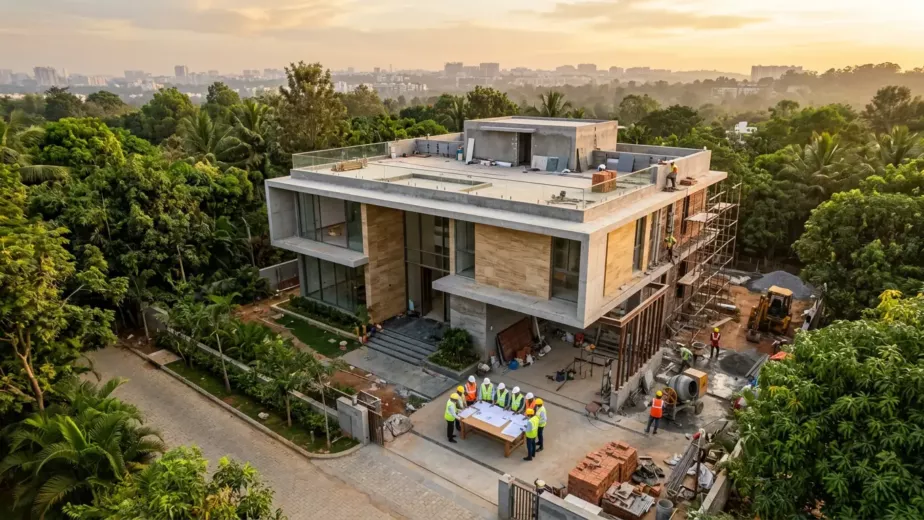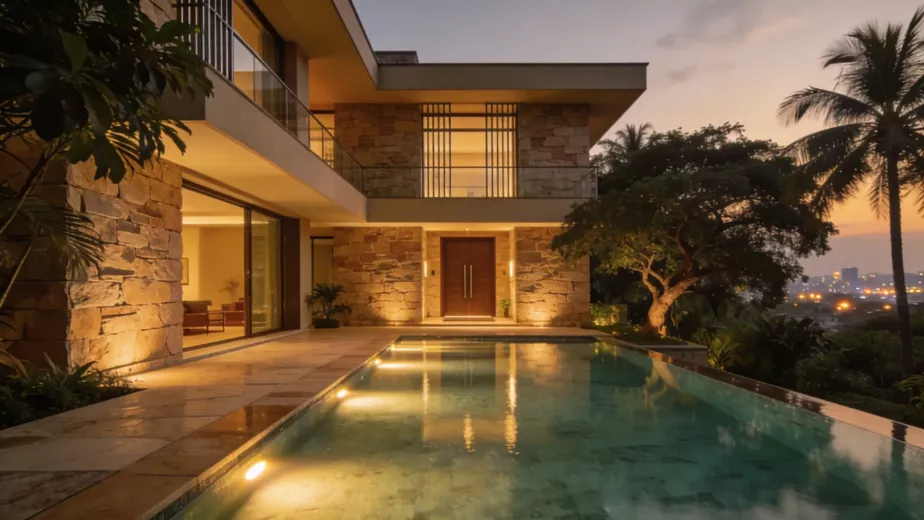

Villa construction companies in Bangalore range from large branded developers to specialized turnkey firms and local civil contractors, each with very different levels of accountability, design capability, and pricing transparency. Choosing the right one depends on whether you own a plot, your budget band, and how much construction oversight you’re willing to take on personally. The safest route in 2026 is an integrated design-build firm with proven villa delivery experience, clear contracts, and full BBMP/BDA compliance support.
TL;DR
- Average villa construction costs in Bangalore range from ₹1,700 to ₹3,500 per sq ft, and luxury specs can push that well past ₹4,500 once interior finishes are factored in.
- There are four distinct types of villa construction companies – general contractors, design-build firms, EPC companies, and turnkey developers – each with very different levels of accountability.
- The design-build model reduces errors, cost overruns, and timeline slippage because architecture and construction stay inside one team.
- Building plan approval in Bangalore typically takes 15 days to 2 months, depending on the authority, plot size, and documentation readiness – your company’s compliance expertise directly affects your start date.
- Every villa construction agreement must include scope of work, material specifications, milestone-linked payments, delay penalties, and warranty terms.
- Devanahalli, Sarjapur Road, Whitefield outskirts, Kanakapura Road, and Bannerghatta Road are the five growth corridors where most premium villa construction is concentrated in 2026.
Why Villa Construction Companies Vary So Dramatically in Bangalore
Here’s something most buyers find out only after they’ve already signed a contract: the phrase “villa construction company in Bangalore” covers a genuinely enormous range of businesses. At one end, you have large structured firms with dedicated design teams, licensed structural engineers, and project management systems. At the other end, you’ll find a sole proprietor with a phone number on a flex banner and three subcontractors he calls on an ad hoc basis.
Both will call themselves villa builders. Both will show you reference photos. The difference in what you actually get, however, is staggering.
Bangalore’s construction sector has grown explosively over the last decade. The city’s tech economy brought in tens of thousands of high-income professionals who wanted independent homes, not apartment units. Villa demand spiked. Builders multiplied. And because entry barriers in civil contracting are relatively low, the market got crowded fast.
The construction cost of a house in Bangalore varies depending on construction quality, materials, and the level of customisation – and that variability is exactly where the gap between genuine full-service companies and opportunistic contractors plays out. A company that cuts corners on M-sand grading or skips proper waterproofing membranes will still quote a competitive per-sq-ft rate. The true cost reveals itself two monsoons later, in seeping walls and compromised foundations.
The buyer who understands this market reality goes in with a completely different set of questions. This guide is written to give you exactly those questions, plus the framework to evaluate the answers you receive.
Types of Villa Construction Companies in Bangalore
Not all construction companies are structured the same way. Understanding what type of company you’re dealing with is step one, because the business model determines who is accountable for what.
General Contractors
General contractors manage site execution. They coordinate labour, source materials, and oversee daily construction activities. What they typically don’t do is design. You bring them an approved architectural drawing, and they build it. The quality of the output depends heavily on the individual site engineer assigned to your project and how many other sites that same engineer is managing simultaneously.
For clients who already have a trusted architect and want to separate design from execution, a reputable general contractor can work well. The risk: when things go wrong, accountability gets diluted across the architect, the contractor, and sometimes even the client.
Design-Build Firms
Design-build firms handle architecture, structural engineering, and construction under one roof. One team, one contract, one point of accountability. When your design team and your construction team are the same people, there are no gaps for errors to fall into. Changes during construction get addressed internally rather than becoming billing disputes between separate vendors.
This model is increasingly preferred by villa buyers in Bangalore, and for good reason. Line of Thought operates as a design-build construction company in Bangalore precisely because integrated delivery is simply better for complex residential projects.
EPC Companies (Engineering, Procurement, Construction)
EPC companies take on the engineering design, material procurement, and physical construction as a single package. They’re common in commercial and industrial projects but are increasingly adopted for high-value residential work. The EPC model offers strong cost control since the company controls its own procurement pipeline, which means less price escalation from third-party supplier mark-ups.
Turnkey Developers
Turnkey developers hand you a finished, fully functional home. From approvals to interior finishes to landscaping, everything is managed by them. You pay a fixed package price (or milestone-linked lump sum) and receive keys when the project is done.
The appeal is obvious. The risk is in understanding exactly what “turnkey” means in the fine print. Some firms call themselves turnkey but exclude modular kitchens, landscaping, and elevation finishing. Always ask for a detailed scope document, not just the package brochure.
Design-Build vs the Contractor Model: Which Works Better for Villa Construction?
This is genuinely one of the most important decisions a villa owner makes, and most buyers don’t realise they’re making it until they’re already mid-project.
The traditional contractor model works like this: you hire an architect to design, then take those drawings to a contractor who builds. Simple in theory. In practice, gaps emerge constantly. The architect designs a double-height living room with specific lighting recesses. The contractor says the ceiling height won’t work with the slab depth they’ve already cast. Now you have a dispute, a delay, and potentially a design compromise.
With the design-build model, that conversation happens on paper before concrete is poured. The architect and structural engineer talk to each other. The site manager flags constructability issues during design review, not during construction.
Here’s what this translates to in real terms for villa projects:
Cost overruns: Design-build firms catch discrepancies before they become expensive corrections on site. Contractor-model projects frequently experience scope creep because the division of responsibility creates grey zones.
Timeline slippage: When design and construction are separate contracts, coordination delays compound. Waiting for revised drawings, re-approvals, and re-submissions adds weeks, sometimes months.
Material quality: In the design-build model, material specifications are locked in at the design stage. In the contractor model, substitutions often happen on site without client knowledge – particularly on items the client can’t easily inspect, like waterproofing compounds or concrete grade.
Single point of accountability: If something goes wrong in a design-build arrangement, you have one entity to hold responsible. In a split contractor arrangement, you’re arbitrating between two separate businesses with conflicting interests.
For villa construction in Bangalore specifically, where projects are complex, plots often have challenging soil conditions, and regulatory compliance requires coordinated expertise, the design-build model isn’t just better – it’s the smarter risk-management choice.

How to Evaluate a Villa Construction Company’s Portfolio
A portfolio is the closest thing you have to a time machine. It shows you what a company has actually delivered, not what it promises to deliver. But not all portfolio reviews are equally useful.
Look at the scale match. A company that has delivered dozens of 1,200 sq ft residential homes is not automatically equipped to deliver your 4,500 sq ft villa with a basement and home automation integration. Ask specifically for completed projects of comparable size and complexity to yours.
Inspect the material quality in person. Photos are curated. Site visits are honest. If a company will allow you to visit a completed project (with client permission), do it. Look at the finish quality on corners, transitions between materials, how bathroom waterproofing has held up, and the quality of electrical and plumbing work. These details reveal construction discipline.
Check on-time delivery record. Ask directly: what percentage of your projects in the past two years were delivered on or before the agreed timeline? A firm that’s proud of its delivery record will answer this without hesitation. Evasive answers are data.
Talk to former clients without the company present. Most companies will provide references, but they’ll be curated. Ask the company for the names of clients from two or three years ago – not recent ones – and reach out independently. Ask what went wrong, not just what went right. Every project has friction points. How a company handles them tells you far more than the final photos.
Look for technical depth, not just aesthetics. Beautiful renders and Instagram-worthy interiors are easy to produce in post-processing. What you want to see is evidence of structural rigour: proper slump tests on concrete, reinforcement drawings, waterproofing specifications, and soil test reports. Companies that genuinely care about build quality will have this documentation ready to show.
Contract Essentials: What Every Villa Construction Agreement Must Include
A lot of construction disputes in Bangalore – and there are many – trace back to one root cause: vague or incomplete contracts. Buyers assume the company will “handle it,” and companies assume the buyer understands what’s excluded. Those assumptions are expensive.
Here’s what a solid villa construction contract must contain:
1. Detailed Scope of Work This is not “villa construction as per plan.” It’s a line-item description of every element: compound wall (yes/no, what specifications), underground sump capacity, overhead tank, borewell, driveway paving, elevation cladding, landscaping. If it’s not written, it’s not included.
2. Material Specifications Brand names and product grades for every major material category. Steel grade (Fe 500 or Fe 550), cement brand and grade, concrete mix design, block type and thickness, waterproofing membrane brand, tile grade and maximum price per sq ft, CP fittings brand, electrical wire brand and rating, paint brand and coat specification. Vague specs like “good quality tiles” are invitations to substitution.
3. Milestone-Linked Payment Schedule Payments should be tied to verifiable construction milestones: completion of foundation, plinth beam, first floor slab, second floor slab, brickwork completion, plastering, flooring, finishing, and handover. Avoid front-loading payments. A reasonable upfront mobilization is 15-20% of contract value. Any company asking for 40-50% upfront before work starts is a red flag.
4. Timeline and Delay Penalties The contract must state an agreed completion date and include a penalty clause for delays beyond that date (unless delays are caused by the client or by force majeure events specifically defined). Without this clause, timeline slippage has no financial consequence for the builder.
5. Change Order Process How are changes handled? What’s the markup on client-initiated changes? What happens when the company discovers unforeseen site conditions? This process must be written, with approval required before additional costs are incurred.
6. Warranty Terms Structural warranty of at least 10 years is standard for reputable firms. Waterproofing warranty of 3-5 years. Non-structural defects covered for at least 1 year post-handover. Any company that refuses to commit warranty terms in writing is worth rethinking.
7. Dispute Resolution Mechanism How are disagreements resolved? Mediation, arbitration, or litigation? Having this agreed upfront saves enormous time and cost if things go sideways.
Understanding Cost Structures at Villa Construction Companies
As of early 2026, average construction rates in Bangalore range from ₹1,700 to ₹3,500+ per sq ft for built-up area, excluding land, approvals, and high-end interiors. But that number, by itself, tells you almost nothing about what you’ll actually pay.
Here’s how to think about villa construction costs properly.
Per Sq Ft vs. Lump Sum Quoting
Most companies quote per sq ft. This is fine for initial comparison, but the critical question is: per sq ft of what? Built-up area (BUA) includes walls and internal spaces. Some companies quote on super built-up area, which inflates the denominator and makes the per-sq-ft rate look lower than it is. Always clarify the measurement base.
Lump sum contracts give you better cost certainty – provided the scope is well-defined. Lump sum with a vague scope is the worst of both worlds. You’re locked into a price for something that hasn’t been fully described.
What’s Typically Included (and Excluded)
These construction cost rates generally include structure, basic finishes, electrical, and plumbing. What they usually exclude – and what can add 30-50% to your base cost – includes:
- Modular kitchen
- Built-in wardrobes and storage
- Home automation systems
- Landscaping and outdoor areas
- Elevation cladding (beyond basic plaster)
- Compound wall and gate
- Borewell and sump
- Lift installation
- Interior design and furniture
Materials account for 50-60% of construction costs, while labour is 20-30% of budget. The rest goes to design, approvals, overheads, and contractor margin.
Approval Costs
Essential BBMP plan approval fees for house construction in Bangalore are ₹1-3 lakhs, based on guidance value, scrutiny, and development charges. NOCs from BESCOM and BWSSB add further costs. Budget for these separately from your construction contract.
The True Cost of a Luxury Villa in Bangalore (2026)
For a 4,000 sq ft luxury villa on your own plot in a growth corridor like Sarjapur or Devanahalli, here’s a realistic cost breakdown:
| Cost Component | Estimated Range |
|---|---|
| Civil construction (structure + basic finish) | ₹68 L – ₹1.4 Cr |
| Premium interior design and execution | ₹40 L – ₹90 L |
| Approvals, NOCs, architect fees | ₹4 L – ₹8 L |
| Landscaping and outdoor areas | ₹5 L – ₹20 L |
| Compound wall, gate, driveway | ₹3 L – ₹8 L |
| Contingency (10-15%) | ₹12 L – ₹30 L |
| Total (excluding land) | ₹1.3 Cr – ₹2.5 Cr+ |
These are ranges, not guarantees. Your actual numbers depend on plot size, number of floors, finish specifications, and the company you choose. What this table does is give you a realistic anchor to test quotes against.
The Role of a Project Manager in Villa Construction: Why It Matters
Most buyers focus almost entirely on the design portfolio and per-sq-ft rate when shortlisting companies. The single most underrated factor in villa construction outcomes is project management quality.
Think about what actually goes wrong on construction sites. Material deliveries don’t arrive on time. Subcontractors need coordination. Site work quality needs daily inspection. Approval documents need follow-up. Client decisions on specifications have to be captured and communicated. Payments to vendors need to be timed correctly. On a villa of 3,500-5,000 sq ft with a 12-18 month timeline, there are hundreds of interdependencies that need active management.
Builder-as-PM vs. Dedicated PM Model
Many smaller contractors operate without a dedicated project manager. The site engineer doubles as the PM, often while managing two or three other sites simultaneously. This works well enough for simple residential builds. It doesn’t work for complex villas.
A dedicated project manager on your project means: – A single person accountable for timeline – Daily quality checks with documented reports – A client communication cadence (weekly updates, monthly reviews) – Proactive issue escalation rather than reactive fire-fighting – Change order documentation that protects both parties
At Line of Thought, every villa project has a dedicated project manager from design sign-off through to handover. This isn’t a luxury add-on – it’s part of how we maintain the delivery standards that our client references reflect. The project manager is the person our clients call, and that person has direct authority over site decisions.
When evaluating any villa builder in Bangalore, ask directly: who is my project manager? How many other projects are they running simultaneously? What is the communication protocol? The answers to these three questions will tell you more about real delivery capability than any portfolio photo.
A Note on Regulatory Compliance: BBMP, BDA, and Why It Can’t Be an Afterthought
This section isn’t in most villa buyer guides. It should be.
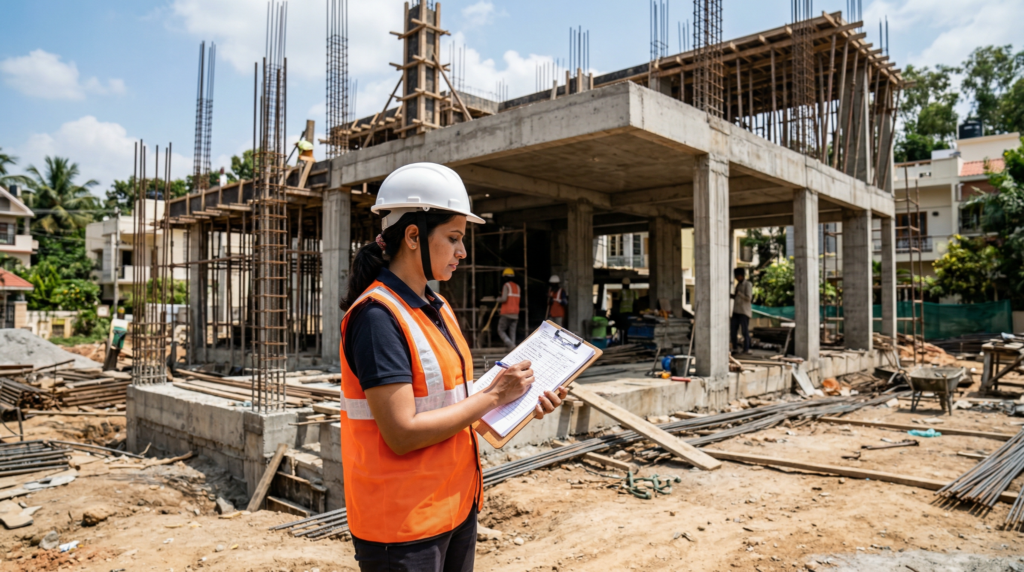
If you fail to take approvals, your construction will be considered unauthorized and can be demolished by the concerned bodies. That’s not theoretical. Demolition notices in Bangalore’s peripheral zones happen, and they happen to villa owners who assumed their builder “handled the approvals.”
Building plan approval in Bangalore typically takes 15 days to 2 months, depending on the authority, plot size, and documentation readiness.
The authority responsible for your approval depends entirely on where your plot sits:
- BBMP (Bruhat Bengaluru Mahanagara Palike): Governs construction within Greater Bangalore city limits. Register on BBMP OBPAS (Online Building Plan Approval System) to begin the submission. A BBMP engineer will inspect the site within 5-7 working days.
- BDA (Bangalore Development Authority): The primary authority for BDA-layout plots. The builder or owner must get the plan approved by BDA before any progress on site. BDA designs a development plan based on the layout plan submitted.
- BMRDA: BMRDA governs development in areas outside BBMP and BDA limits. A BMRDA-approved layout means the plotted development has been verified and cleared for proper road width, drainage, parks, and adherence to land use zoning.
- BIAPPA: Governs plots near the Kempegowda International Airport zone. Because of extra verifications near the airport zone, approvals can take 45 days to 2 months.
Only licensed architects or engineers can prepare the building plan for submission. Along with the plan, you’ll need key documents like the sale deed, Khata, property tax receipts, and NOCs (if required).
The Occupancy Certificate (OC) is a mandatory legal document issued by authorities after construction is completed as per the approved building plan. While plan approval allows you to begin construction, the OC certifies that the building complies with sanctioned plans, safety norms, and local by-laws, making it legally fit for occupation.
Without an OC, property owners may face difficulties in obtaining water and electricity connections, property registration, resale, or rental, and may also attract legal penalties.
Choose a villa construction company that treats approvals as a core competency, not a side task. At Line of Thought, our team manages the full BBMP/BDA/BIAPPA approval chain as part of every project engagement, because delays at the approval stage cascade across the entire construction timeline.
Top Localities Where Villa Construction Companies Operate in Bangalore
Bangalore’s villa construction activity is concentrated in specific growth corridors, each with distinct characteristics, plot availability, and approval frameworks.
Devanahalli (North Bangalore)
The fastest-growing villa zone in Bangalore’s northern corridor. Proximity to Kempegowda International Airport makes it attractive for frequent flyers and NRI buyers. Large plot sizes are still available at relatively accessible land prices compared to mature south-Bangalore corridors. Construction here falls under BIAPPA jurisdiction – approval timelines can be longer, so choose a company with BIAPPA-specific experience.
Sarjapur Road
The IT corridor connection makes Sarjapur consistently high-demand. Sarjapur plots near Wipro, Infosys, and the RGA Tech Park cluster attract buyers who want independent homes close to work. Plot sizes are smaller than North Bangalore, but the resale and rental market is strong. Soil conditions here can vary significantly – always insist on a soil test before finalising your foundation design.
Kanakapura Road
Kanakapura has become Bangalore’s wellness and green living corridor, with several eco-resort communities and premium villa projects along its stretch. Its relatively lower current land prices (compared to Sarjapur or Whitefield) and the Forest Road character attract buyers who want a quieter build environment. BDA and BMRDA approvals are common here.
Whitefield Outskirts (Hoskote, Budigere Cross)
Core Whitefield is dense and expensive. The outskirts – particularly toward Hoskote and Budigere Cross on the Old Madras Road side – offer larger plots at better prices. The IT ecosystem nearby keeps rental demand strong for well-built villas. BBMP versus Gram Panchayat jurisdiction can vary even within a small radius here, so verify plot jurisdiction carefully before purchase.
Bannerghatta Road
South Bangalore’s green belt corridor. Bannerghatta Road plots have good connectivity to Jayanagar, JP Nagar, and Electronic City. The area appeals to buyers who want South Bangalore’s established infrastructure combined with independent home living. Plot sizes tend to be smaller than the peripheral corridors, and construction costs skew slightly higher because of labour and material logistics in this denser area.
Smart Home Integration and Sustainable Features: What to Plan for in 2026
Most villa construction guides ignore this section entirely. That’s a mistake, because decisions made at the construction stage either enable or permanently prevent smart home and sustainability features. Retrofitting is expensive. Planning ahead is not.
Conduit Routing for Home Automation:
If you’re planning to add smart lighting, climate control, or security systems – even in the future – your construction company must route conduits during the slab and wall construction phase. This costs almost nothing at the construction stage. After the walls are finished, it costs a fortune.
Solar Preparation:
Solar panel mounting points and cable runs from the roof to the electrical panel should be part of the construction drawing. The actual solar installation can come later, but the provision must be made during construction.
Rainwater Harvesting:
Bangalore’s water table has declined significantly over the past decade. BBMP and BDA increasingly require rainwater harvesting provisions for new constructions. A good villa construction company will design this into the civil work, not suggest it as an afterthought.
EV Charging Provision:
With electric vehicle adoption accelerating across Bangalore’s tech-professional demographic, dedicated EV charging points in the garage (with proper earthing and circuit capacity) are worth specifying at the construction stage.
Natural Ventilation Design:
Bangalore’s climate rewards good passive design. Cross-ventilation, appropriate window placement, and roof design that reduces heat gain can meaningfully reduce your ongoing air conditioning load. This is architectural, not add-on technology – it needs to be in the design from the start.
5 Red Flags When Evaluating Villa Construction Companies in Bangalore
These are the patterns that consistently appear in problematic projects.
1. No dedicated structural engineer on the team. A company that relies entirely on an architect for structural design without a licensed structural engineer is a risk. Villas above G+1 require proper structural calculations. Ask for the structural engineer’s credentials and registration.
2. Asking for more than 25% upfront before work starts. There’s no legitimate reason a well-capitalized construction company needs half the project value before breaking ground. High upfront demands often indicate cash flow problems being solved at the client’s expense.
3. Unwillingness to provide client references from two or more years ago. Recent references are selected for satisfaction. Two-year-old clients have lived with the build. They know what cracked, what leaked, and what wasn’t worth the premium.
4. Vague BOQ (Bill of Quantities). If the detailed estimate says “tiles as per client selection” without a price ceiling, or “electrical as per drawings” without specifying wire gauge and brand, the scope is incomplete. You’re agreeing to a price you can’t actually calculate.
5. No written change order process. “We’ll figure it out as we go” is how verbal agreements become billing surprises. Every change, however small, should have a written record with cost and timeline impact before the work proceeds.
Why Line of Thought Leads Among Villa Construction Companies in Bangalore
There are hundreds of firms that will build you a villa in Bangalore. The question worth asking is: how many of them have the combined expertise to design it thoughtfully, engineer it correctly, build it with discipline, and finish it beautifully – all within a single coordinated system?
Line of Thought operates as an integrated EPC and design-build firm. Our team brings together licensed architects, structural engineers, interior designers, and construction professionals under a single project framework. Every engagement starts with design intent and ends with a fully finished, occupied home – not just a shell handed over with a snag list.
What makes the difference in practice:
Integrated Design + Construction: Our interior design team in Bangalore and construction team work from the same set of drawings. Interior decisions – lighting positions, millwork depths, material transitions – are resolved before the slab is poured, not negotiated after. This eliminates the most common source of villa construction cost overruns.
VR Design Previews: Before a single rupee of construction cost is committed, clients at Line of Thought walk through photorealistic VR previews of their home. Design decisions that would otherwise become expensive mid-construction changes get resolved at the drawing stage, where changes cost nothing. If you’re planning a villa and want to discuss your design, construction requirements, and project scope before getting started, book a free villa construction consultation.
Transparent Pricing: Our quotes are BOQ-based, not per-sq-ft approximations with a long exclusions list. Clients know exactly what materials are specified, what brands are committed, and what the contingency allowance covers.
BBMP/BDA/BIAPPA Compliance Expertise: Our team has navigated the full range of Bangalore’s approval authorities across multiple projects in all major growth corridors. Approval management is a first-party responsibility, not something we delegate to a consultant after you’ve signed.
Dedicated Project Management: Every project has a named PM with direct client contact, a weekly reporting cadence, and milestone-based progress tracking.
For clients considering renovation services in Bangalore alongside villa construction – whether updating an existing home or transforming an older bungalow into a modern villa – Line of Thought brings the same integrated methodology that ensures design intent survives from concept to completion.
Visit thelineofthought.com to explore completed projects, request a consultation, or start a conversation about your villa project.
FAQs: Villa Construction Companies in Bangalore
What is the average cost of villa construction in Bangalore in 2026?
As of early 2026, average construction rates in Bangalore range from ₹1,700 to ₹3,500+ per sq ft for built-up area, excluding land, approvals, and high-end interiors. For a luxury villa with premium finishes, the all-in construction and interior cost typically falls between ₹3,500 and ₹5,500 per sq ft. Add approvals, landscaping, and contingency on top of that for your total project budget.
How long does it take to build a villa in Bangalore?
A typical G+2 house in Bangalore usually takes 12 to 15 months, including the 3 months required for pre-construction approvals. A larger or more complex villa on a 4,000-6,000 sq ft built-up area can take 18-24 months depending on approvals, design complexity, and monsoon-related site stoppages. Add 2-3 months for interior fit-out if not done concurrently.
What approvals are needed before starting villa construction in Bangalore?
You need building plan approval from the relevant authority for your plot jurisdiction – BBMP for plots within Greater Bangalore, BDA for BDA-layout plots, BMRDA for peripheral areas, and BIAPPA for plots near the airport corridor. You need BBMP or BDA plan approval first. Get Khata, then submit drawings. Also, NOC from BESCOM for power, BWSSB for water (if multi-floor, fire NOC too).
What is the difference between a turnkey villa construction company and a regular contractor?
A regular contractor builds to your architect’s design and hands over a structure. A turnkey villa construction company takes complete responsibility for everything from design, approvals, construction, interior fit-out, and landscaping – to final handover with all systems functional. The distinction matters for accountability: with a turnkey company, there is one entity responsible for the complete outcome.
How do I verify if a villa construction company is legitimate in Bangalore?
Check for GST registration, verify the company’s office address physically, ask for their licensed architect and structural engineer’s registration numbers, request client references from completed projects (not just ongoing ones), and visit at least one completed project in person. For companies selling villa units (rather than constructing on your plot), verify RERA registration on Karnataka’s RERA portal.
What should a villa construction contract include?
At minimum: detailed scope of work (what is and isn’t included), material specifications with brand names and grades, milestone-linked payment schedule, completion date with delay penalty clause, change order process, warranty terms (typically 10 years structural, 3-5 years waterproofing, 1 year non-structural), and a dispute resolution mechanism. A contract missing any of these elements is incomplete.
Is the design-build model better for villa construction than hiring separate architects and contractors?
For most villa buyers, yes. The design-build model keeps design intent and construction accountability under one roof. It reduces coordination gaps, eliminates billing disputes between separate vendors, and typically results in better cost and timeline predictability. The main advantage is single-point accountability – one team, one contract, one entity to hold responsible for the outcome.
Which localities in Bangalore are best for villa construction in 2026?
Devanahalli, Sarjapur Road, Kanakapura Road, Whitefield outskirts (Budigere Cross, Hoskote), and Bannerghatta Road are the five primary villa growth corridors in 2026. Each has distinct land price points, approval authorities, and infrastructure maturity levels. Devanahalli offers the largest plots at the most accessible prices. Sarjapur has the strongest rental demand from the IT workforce.
How are change orders handled during villa construction, and what should I watch for?
Every client-initiated change or unforeseen site condition that affects scope, cost, or timeline should generate a written change order document – describing what changed, what it costs, and how it affects the timeline – before the work proceeds. Watch out for companies that make changes verbally and present a bill at handover. That bill is always larger than expected.
What is the typical warranty offered by villa construction companies in Bangalore?
Reputable villa construction firms offer a structural warranty of 10 years covering foundation, columns, beams, and slabs. Waterproofing warranties typically run 3-5 years. Non-structural defects (plaster cracks, fixture issues, paint) are generally covered for 1 year post-handover. Always get warranty terms in writing as part of the contract, not as a verbal assurance at handover.
Key Takeaways
- Villa construction companies in Bangalore span general contractors, design-build firms, EPC companies, and turnkey developers – each with very different accountability structures. Match the company type to your project complexity and risk tolerance.
- The average residential construction cost per sq ft in Bangalore ranges from ₹1,700 to ₹3,500, but luxury villas with full interior fit-out can reach ₹4,500-₹5,500+ per sq ft all-in.
- The design-build model consistently outperforms the split architect-contractor model for villas, primarily because it eliminates coordination gaps and keeps accountability unified.
- Every villa construction contract must lock in material specifications by brand and grade – not by vague description. Vague specs become substitution opportunities.
- Building plan approval in Bangalore typically takes 15 days to 2 months, depending on the authority, plot size, and documentation readiness – factor this into your project timeline before breaking ground.
- Without an Occupancy Certificate, property owners may face difficulties in obtaining water and electricity connections, property registration, resale, or rental. Treat OC acquisition as non-negotiable.
- Project management quality is the most underrated factor in villa construction outcomes. A dedicated PM with clear authority and a communication cadence prevents the majority of delays and cost overruns.
- Devanahalli, Sarjapur Road, Kanakapura Road, Whitefield outskirts, and Bannerghatta Road are Bangalore’s five active villa construction corridors, each with different approval frameworks and infrastructure maturity.
- Smart home conduit routing, solar provision, rainwater harvesting, and EV charging should be designed into civil work from the start – retrofitting these features after construction is disproportionately expensive.
- Evaluate companies on portfolio scale match, structural engineering credentials, change order process, and willingness to commit warranty terms in writing. These four factors separate serious firms from opportunistic ones.