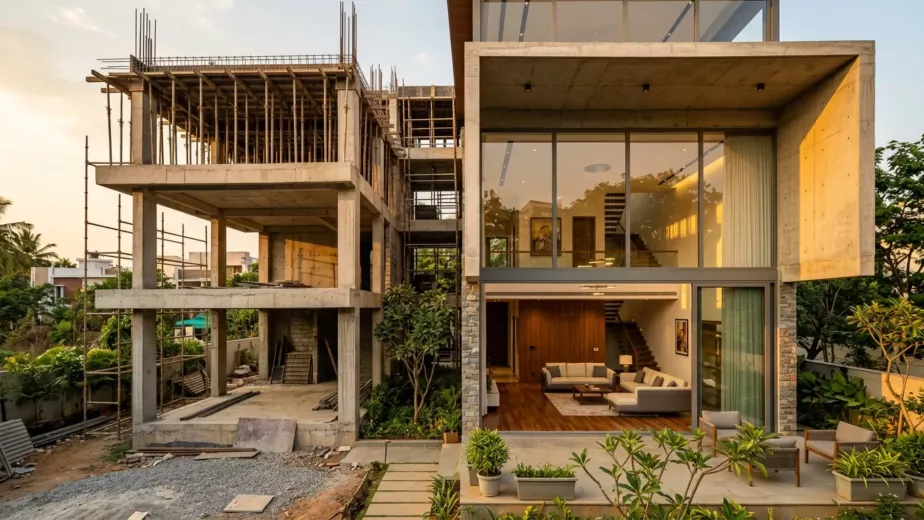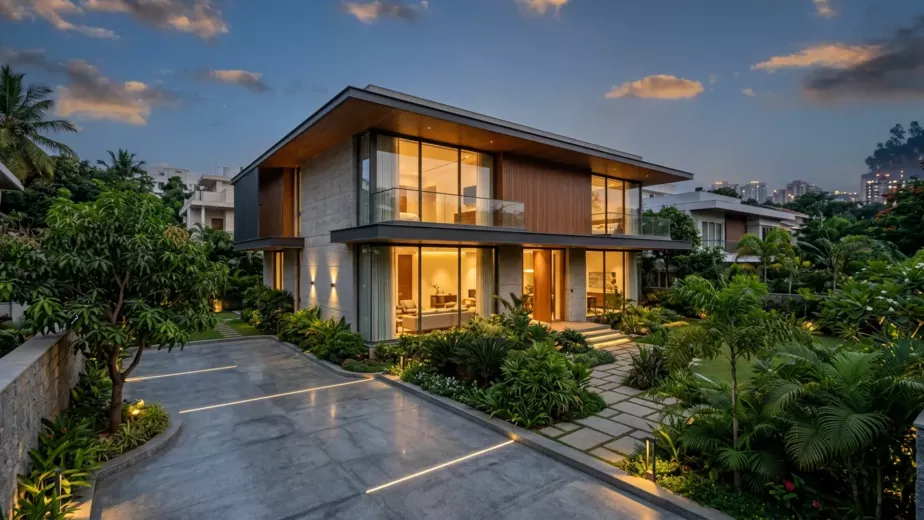
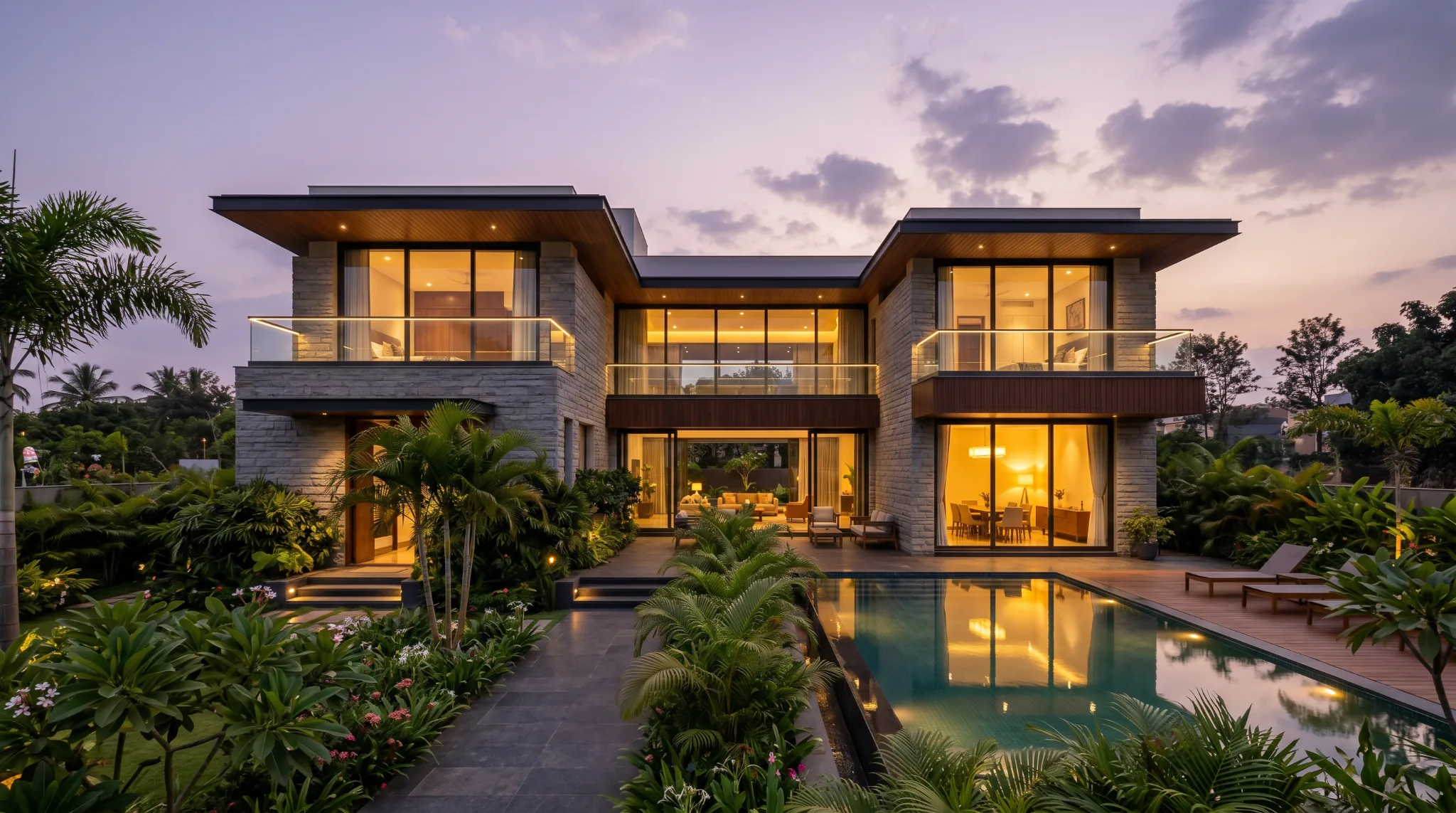
The best construction company in Bangalore combines structural engineering rigor, transparent project management, and full BBMP/RERA regulatory compliance – not just years in business or portfolio size. In 2026, top builders are further separated by their use of BIM technology, verified material standards, and post-handover support systems. If you’re evaluating firms, these are the benchmarks that actually protect your investment.
TL;DR
- “Best” means structural quality, transparency, compliance, and after-sales support – not just age or brand name.
- Construction costs in Bangalore vary widely in 2026, and the average residential cost per sq ft ranges from Rs. 1,700 to Rs. 3,500, depending on quality, materials, and customisation level.
- Top builders use BIM, drone monitoring, and digital BOQ management – not just experience alone.
- Karnataka has seen over 12,000 RERA complaints, with an 80% disposal rate – showing how active enforcement has become and why compliance history matters before you sign anything.
- Sustainability practices – rainwater harvesting, eco-materials, IGBC alignment – are now standard expectations at the premium level, not optional add-ons.
- Post-handover support, defect liability periods, and a responsive after-sales team separate genuinely great builders from firms that disappear after keys are handed over.
What ‘Best’ Actually Means When Evaluating a Construction Company in Bangalore
Let’s be honest: the word “best” gets thrown around a lot in construction marketing. Every brochure promises quality. Every sales deck shows polished renders. So how do you actually evaluate which construction company deserves your trust – and your budget?
The answer starts by shifting your criteria. Most homeowners make the mistake of filtering by company age or portfolio size. Neither tells you what you actually need to know.
What genuinely distinguishes a top construction company in Bangalore comes down to five benchmarks:
1. Structural Integrity
Does the company have in-house structural engineers or does it outsource critical design decisions? Are there documented quality checks at foundation stage? A beautifully finished home built on a compromised structure is a ticking problem.
2. Design Capability
Can the firm translate your vision into a technically sound, buildable plan? Good design isn’t just aesthetics. It’s spatial planning, material compatibility, and constructability all working together.
3. Regulatory Compliance
BBMP plan approvals, RERA registration (where applicable), BESCOM NOCs – ensuring full compliance with BBMP, BDA, RERA, BESCOM, and environmental laws is what creates a legally approved, structurally sound, and hassle-free home. Firms that cut corners here create problems for you years down the line.
4. Transparency
Are costs shared upfront with a detailed Bill of Quantities? Or do you discover “extras” halfway through construction? The best firms eliminate this ambiguity before work begins.
5. After-Sales Support
What happens after handover? Defect liability periods, structural warranties, and an actual responsive team to call when something needs attention – these matter more than most buyers realize until they need them.
Size matters a lot less than people assume. Some of Bangalore’s most reliable construction partners are mid-sized firms with deep process discipline. And some large firms with famous names have chronic delivery and quality issues.
Structural Engineering Excellence: The Core of Any Great Construction Company
This is where the real difference lives – and it’s the part most homeowners never think to ask about until something goes wrong.
Here’s the reality: structural failure in residential construction rarely looks dramatic at first. It shows up slowly. A crack here. Seepage there. A floor that sounds hollow. By the time it becomes visible and undeniable, it’s expensive.
The best construction companies in Bangalore protect against this in three ways:
In-house vs Outsourced Structural Engineers
Top firms keep structural engineers on their permanent team – not on a project-by-project consulting basis. This matters because in-house engineers develop familiarity with the firm’s standard specifications, preferred material brands, and construction methods. They’re accountable for outcomes across multiple projects, not just paid for a design drawing and forgotten.
Outsourced structural work isn’t automatically inferior, but it requires much stronger coordination and oversight. Ask any firm you’re evaluating: “Who does your structural engineering, and are they employed by you directly?”
Design Review Processes
Before a single RCC pour happens, the best firms run thorough design reviews. This means verifying that architectural and structural drawings are compatible, checking that electrical and plumbing layouts don’t compromise structural members, and confirming that the design meets seismic zone requirements. Bangalore lies in a moderate seismic zone, and responsible construction follows IS 1893:2016 standards to ensure earthquake resistance is built into every project.
Foundation Stage Quality Checks
This is non-negotiable. A great construction company treats the foundation stage as the most critical phase, not something to rush through before the visible work begins. Soil testing, concrete mix verification, rebar placement checks, curing supervision – these happen systematically, with documentation.
The firms that skip or abbreviate these steps consistently produce projects with long-term issues. The firms that are serious about them produce homes that age well.
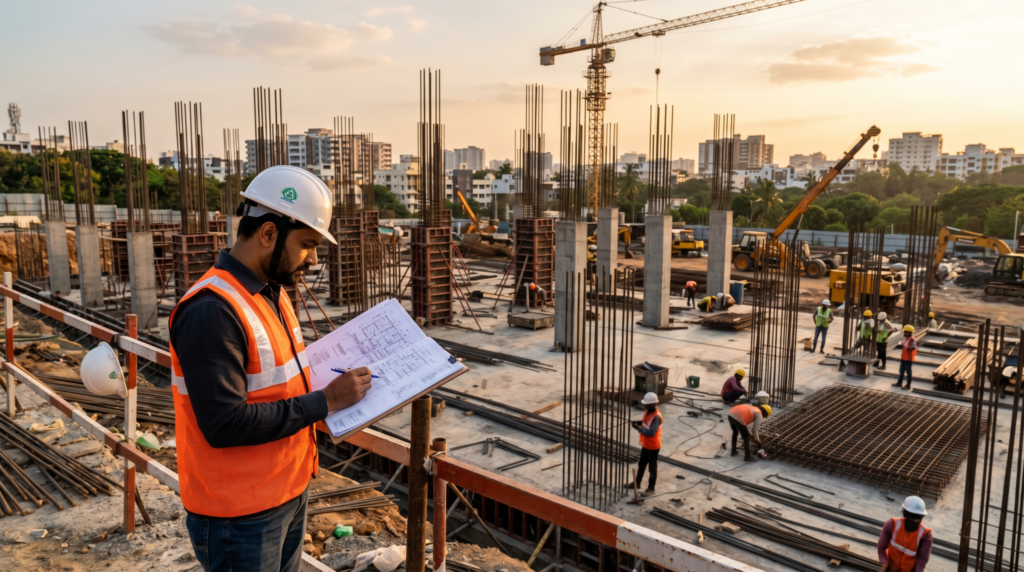
Technology Adoption: How the Best Construction Companies Work in 2026
This section is worth reading carefully if you’ve been shopping around for a construction company and found yourself getting vague answers about “project management” and “quality control.” In 2026, how a firm uses technology is a direct indicator of how well it manages its projects.
Building Information Modeling (BIM)
BIM is the closest thing construction has to a digital twin of your building before it exists. The best firms use it to design, coordinate, and detect clashes between structural, architectural, and MEP systems before construction begins. This means fewer surprises during execution. Fewer surprises means fewer cost escalations.
VR Walkthroughs Before Construction Begins
This one is genuinely useful for clients, not just a gimmick. Before work starts, you walk through a rendered version of your home in a virtual environment. You catch things you’d never spot in a floor plan – sight lines, ceiling heights, door swing conflicts, where natural light actually lands at different times of day. Changes at this stage cost almost nothing. Changes during construction can cost significantly.
Drone Site Monitoring
Regular drone surveys allow project managers to document actual progress against planned timelines with aerial precision. It helps catch discrepancies early – a column in the wrong position, a retaining wall that’s drifted, drainage work that wasn’t completed before it got covered. It also gives clients visual proof of progress without requiring daily site visits.
App-Based Project Tracking
The best construction companies now offer clients a dedicated project management app. You get daily updates, photo logs, milestone confirmations, and direct communication with your project manager – all in one place. No more chasing contractors for status updates or showing up unannounced to see what’s happening.
Digital BOQ Management
A digital Bill of Quantities that’s updated in real time means you always know where your budget stands. Material specifications are logged against what’s actually been procured and used. This level of financial transparency is what separates companies serious about accountability from those that give you a final bill with surprises baked in.
Material Quality Standards: What Top Companies Specify and Why
Here’s something most homeowners don’t fully appreciate until they’re mid-construction: not all materials sold as “standard” are actually equivalent. The difference between two contractors’ bids is often explained entirely by what goes into the walls, slabs, and waterproofing – not by labor costs.
ISI-Marked Materials
The Bureau of Indian Standards (BIS) ISI certification means a product has been tested against a national quality standard. The best construction companies in Bangalore specify ISI-marked materials across the board – cement, electrical wiring, pipes, fittings. This isn’t premium; it’s the baseline for responsible construction.
Concrete Mix Design
A concrete mix design isn’t the same as just mixing cement and aggregates at site. A proper mix design accounts for the specific grade of concrete required at each structural element, the water-cement ratio, aggregate size, and admixtures where needed. The average construction cost for standard quality in Bangalore is around Rs. 2,400 per sq ft in 2026, with basic quality starting at approximately Rs. 1,872 per sq ft and premium at around Rs. 3,240 per sq ft – and much of this cost variance comes down to whether concrete mix design and material grade are properly controlled.
Steel Grade: Fe500D
Not all TMT bars are equal. The best construction companies specify Fe500D grade TMT steel – the “D” denotes higher ductility, which means the steel can absorb more energy before failure. This is particularly relevant given Bangalore’s seismic zone classification. TMT Fe500D steel bar prices in Bangalore currently range from Rs. 60-69 per kg depending on diameter, with major brands including TATA Tiscon, JSW NeoSteel, and Vizag Steel.
Waterproofing Systems
Seepage is one of the most common – and most preventable – complaints in Indian residential construction. Professional waterproofing isn’t just a coating applied as an afterthought. It’s a system: surface preparation, primer coats, membrane application, and protection layers, all applied under proper curing conditions. Top firms specify this as a documented scope item, not a field decision left to whoever is on site that day.
Branded vs. Unbranded Materials
The price difference between using verified branded materials and unbranded alternatives is often 8-12% of the total material cost. The long-term cost of using inferior materials – in repairs, replacements, and structural remediation – is far higher. Top firms absorb or transparently pass on the difference because they understand this math.
Project Management: The Difference Between Good and Great Construction Companies
Most construction problems aren’t engineering failures. They’re coordination failures.
A structure that’s technically sound but delivered nine months late with three rounds of rework and a client who’s been kept in the dark isn’t a success. Great project management prevents exactly this. Here’s what it actually looks like at the best construction companies in Bangalore:
Dedicated Project Manager (PM)
Not a site foreman who manages multiple projects simultaneously while also handling procurement. A dedicated PM means one person whose primary responsibility is your project – tracking the schedule, coordinating trades, managing material deliveries, and communicating with you.
Daily Reporting
Daily site logs – photographic and written – create an unbroken record of what happened each day. This documentation serves two purposes: it keeps the PM accountable, and it gives the client confidence. If something goes wrong, there’s a paper trail. If work goes ahead as planned, you can see it.
Milestone Sign-offs
Construction projects should have defined milestones with client sign-off required before the next phase begins. Foundation complete. Plinth beam done. Slab cast. Frame complete. This isn’t bureaucracy; it’s structured quality control that keeps everyone aligned.
Escalation Protocols
What happens when something unexpected comes up – a utility line in an unexpected location, a subcontractor delay, a material that’s not available? Good firms have defined escalation paths. You get a call within a specific timeframe. The issue gets documented. A resolution plan is shared. You’re not left wondering.
Client Communication Frequency
The best firms establish clear communication cadences at the start of a project: daily updates via app, weekly calls, fortnightly site visits, monthly progress reports. These aren’t optional extras. They’re part of the project delivery model.
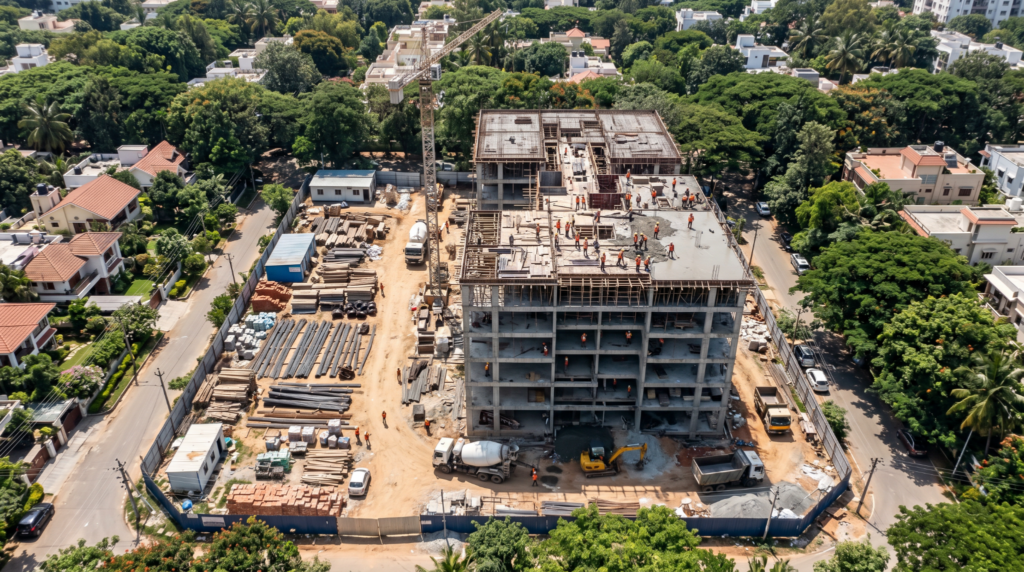
Regulatory Compliance Track Record: BBMP, BDA, RERA
Compliance with Bangalore’s regulatory framework is table stakes in 2026. But a company’s compliance track record – how it has handled approvals, notifications, and obligations across past projects – tells you a great deal about its professional integrity.
Understanding the Approval Landscape
Bangalore’s residential construction sits within three main jurisdictions: BBMP (Bruhat Bengaluru Mahanagara Palike), BDA (Bangalore Development Authority), and BMRDA for plots outside these limits. Each has its own approval process.
Building plan approval in Bangalore typically takes 15 days to 2 months, depending on the authority, plot size, and documentation readiness. A firm that’s done this dozens of times handles it smoothly. A firm without this experience can leave you waiting far longer.
RERA: What It Protects You From
The Real Estate Regulation and Development Act, 2016 was introduced by the Government of India to regulate the real estate sector and protect homebuyers. For projects above the applicable threshold, RERA registration is mandatory. Under RERA, builders are required to keep 70% of the payment received from homebuyers in a separate account reserved for construction purposes only.
Under the RERA Act, selling or advertising a project without registration can attract a penalty of up to 10% of the estimated project cost.
How to Check a Company’s Regulatory Track Record
- Visit rera.karnataka.gov.in and search for the firm’s registered projects
- Confirm the project is registered with RERA Karnataka via their portal, and look for the project’s registration number, completion timeline, and legal approvals.
- Check BBMP’s e-portal for plan sanction history on completed projects
- Ask the company directly for copies of approved drawings and commencement certificates from past projects – a firm with nothing to hide produces these without hesitation
The e-Khata Factor
Properties must have a valid e-Khata, mandatory for registrations since October 2024 – use BBMP’s online portal or e-Khata kiosks to check or apply, as missing e-Khata can block loans or property sales, and 80% of transactions now require it. Your construction company should be able to advise you on this and assist where needed.
Sustainability Practices: Why Top Construction Companies Build Green
Five years ago, sustainability in construction was a differentiator. In 2026, it’s become a core expectation – at least among clients investing in premium residential and villa construction in Bangalore.
The best firms aren’t implementing green practices as marketing. They’re doing it because it’s the right way to build, and because clients increasingly demand it.
Energy-Efficient Design
This starts at the design stage – not as an add-on. Orientation of the building to maximize natural light and cross-ventilation, high-performance insulation, energy-efficient windows with low solar heat gain coefficients, and integration of solar panel infrastructure from the build stage rather than retro-fitting later.
Water Conservation
Rainwater harvesting is being integrated as a standard feature in responsible construction projects, not treated as an optional add-on. Greywater recycling for landscaping and toilet flushing, low-flow fixtures throughout, and groundwater recharge wells are all becoming expected components of responsible residential construction in Bangalore.
Waste Management During Construction
Construction waste is a significant and often invisible environmental cost. Top firms develop waste management plans before projects begin: on-site sorting of recyclable materials, responsible disposal of non-recyclable waste, and supplier take-back programs for excess packaging. The best firms also track their waste diversion rates as a project metric, not an afterthought.
Eco-Materials and Embodied Carbon
Choosing materials with lower embodied carbon – fly ash bricks over red clay bricks, M-Sand over river sand where appropriate – reduces the environmental footprint of a project without compromising structural performance. M-Sand (manufactured sand) is cheaper than river sand in Bangalore at Rs. 1,300-1,700 per tonne and is preferred for concrete work.
IGBC Alignment
The Indian Green Building Council (IGBC) provides a certification framework that the best premium builders align their practices with. It’s not just a label. It drives a structured approach to site planning, material selection, water efficiency, energy performance, and indoor environment quality.
Post-Handover Support: What Separates Good from Great Builders
The handover day is exciting. You walk through your completed home, you receive the keys, and you feel like the hard part is over. But here’s the truth most builders don’t advertise: the relationship doesn’t end there. How a construction company behaves after handover tells you everything about its character.
Defect Liability Period
Under RERA, the developer is responsible for any defects in the building for up to 5 years. If any damage to the property occurs during the first five years, a resolution needs to be met within 30 days. The best construction companies go beyond bare minimum compliance – they treat the defect liability period as an opportunity to demonstrate the quality of what they built.
Structural Warranty Norms
Separate from the defect liability period, structural warranties from reputable firms cover the core structural elements – foundation, columns, beams, slabs – for longer periods. Ask any company you’re evaluating what their specific structural warranty covers and for how long. The answer will tell you how confident they are in what they build.
After-Sales Team
A dedicated after-sales or client relations team – not the construction PM who’s already moved to the next project – means there’s someone accountable for addressing your concerns post-handover. This includes scheduling warranty inspections, coordinating repair work, and ensuring that any quality issues identified in the first year are resolved properly.
Emergency Response
What happens if there’s a significant issue after handover – a roof leak before the first monsoon, a structural crack that appears in the first year? The best firms have a clear emergency response protocol. You know who to call, what to expect in terms of response time, and how the resolution process works.
Construction Cost in Bangalore 2026: What to Expect and Plan For
Understanding realistic costs is part of making a smart decision when selecting a construction company. Too many homeowners get drawn in by suspiciously low per-sq-ft quotes, only to discover that material specifications and project scope were quietly downgraded.
Here’s a straightforward picture of where costs stand right now:
As of early 2026, average construction rates in Bangalore range from Rs. 1,700 to Rs. 3,500 per sq ft for built-up area, excluding land, approvals, and high-end interiors. These rates typically include structure, basic finishes, electrical, and plumbing.
| Construction Quality | Approximate Cost Per Sq Ft (2026) |
|---|---|
| Basic | Rs. 1,700 – Rs. 1,900 |
| Standard | Rs. 2,000 – Rs. 2,500 |
| Premium | Rs. 2,600 – Rs. 3,500 |
| Luxury / Villa | Rs. 3,500 and above |
A few important notes on this table:
- Materials account for 50-60% of costs, while labour accounts for 20-30% of the budget, with labour costs for house construction in Bangalore running approximately Rs. 400-700 per sq ft.
- Central areas like Koramangala and Indiranagar run 15-25% higher than suburban areas like the Whitefield outskirts and Electronic City.
- Architect fees typically add 5-8% of the project cost, and finishes and interiors for a house in Bangalore add Rs. 500-1,500 per sq ft extra for modular kitchens, wardrobes, and lifts.
- Essential BBMP plan approval fees for house construction in Bangalore range from Rs. 1-3 lakhs based on guidance value and scrutiny charges, with additional NOCs from BESCOM and BWSSB adding further costs.
When you’re comparing quotes from multiple firms, always ask for an itemized BOQ that specifies material grades. A Rs. 400 per sq ft difference between two quotes often vanishes when you standardize for the same concrete grade, steel specification, tile quality, and waterproofing scope.
How to Evaluate a Construction Company Before You Commit: A Practical Checklist
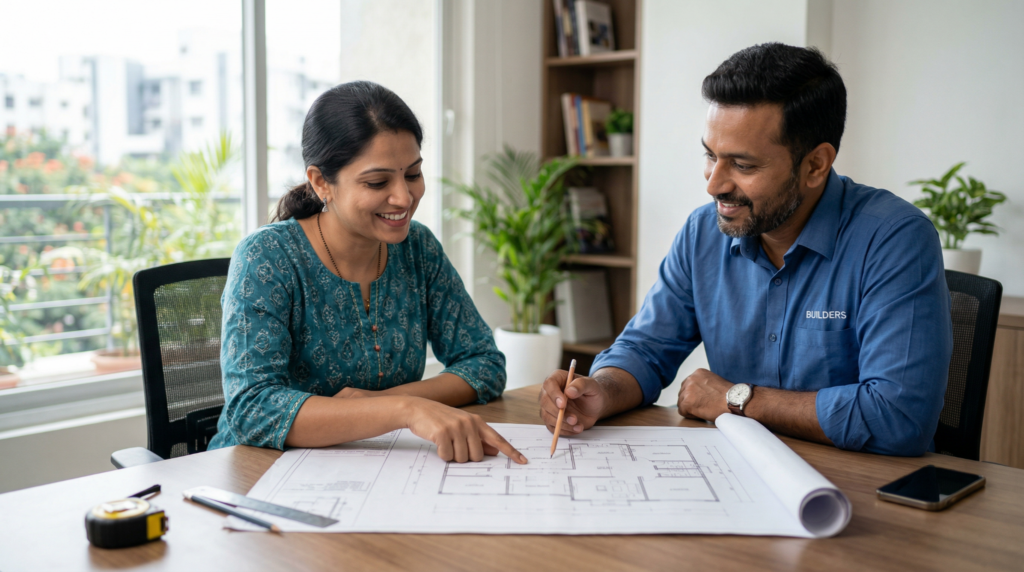
Most blog posts stop at telling you what to look for. Here’s an actual process you can follow when shortlisting and evaluating construction companies in Bangalore:
Step 1: Visit at Least Two Completed Projects
Not renders. Not site visits to ongoing work. Completed, occupied projects where you can look at actual finishes, check for seepage stains, feel the quality of joinery, and ideally speak with the client who commissioned the work.
Step 2: Ask for the Structural Engineer’s Credentials
Name, qualification, and whether they’re in-house or consulting. A firm that’s proud of its technical team will share this without hesitation.
Step 3: Request a Sample BOQ from a Similar Past Project
This shows you how the company structures its specifications and costs. It’s the fastest way to assess whether they’re transparent or deliberately vague.
Step 4: Check Regulatory History
Look up the firm on rera.karnataka.gov.in. Ask for BBMP plan sanction copies from past projects. Ask whether they’ve ever had complaints filed against them and how those were resolved.
Step 5: Understand the PM Structure
Who will manage your project? Is this person dedicated to your project or managing four others simultaneously? What is their reporting frequency to you?
Step 6: Clarify the Payment Schedule
Reputable firms tie payments to construction milestones, not arbitrary calendar dates. If a firm asks for large upfront payments before significant work has been completed, take that seriously.
Step 7: Understand the After-Sales Process
Ask specifically: What is your defect liability period? What does your structural warranty cover? Who is my contact after handover? How do I raise a warranty claim?
What Top Builders in Bangalore Are Doing Differently in 2026
The Google AI overview of Bangalore’s construction landscape calls out a few clear patterns among the firms that consistently deliver quality. Looking at what differentiates the best – whether large or boutique – reveals some consistent behaviors:
Vertical Integration Where It Counts
The firms consistently rated highest for quality maintain in-house capabilities for the most critical project phases: structural engineering, quality control, and procurement of key materials. This doesn’t mean they do everything themselves, but they don’t outsource accountability.
Technology as a Process, Not a Marketing Point
Companies that actually use BIM, project management apps, and digital BOQs operationally are measurably better at delivering on time and on budget. The difference between a company that has these tools and one that uses them is visible in project outcomes.
Client Communication as a Competitive Advantage
The best builders have realized that keeping clients informed proactively – before the client has to ask – builds more trust and leads to more referrals than any marketing spend. Regular updates, honest progress reports, and early communication of potential issues have become genuine differentiators.
Sustainability as Standard
Premium construction clients in Bangalore increasingly ask about energy efficiency, IGBC alignment, and sustainable material choices. The top builders don’t offer these as paid upgrades. They’ve made them part of their standard design and execution process.
Pre-Construction Phase Investment
Great builders spend more time and rigor in the pre-construction phase – detailed drawings, clash detection, soil testing, regulatory approvals – before breaking ground. This front-loaded investment pays off in fewer surprises, fewer delays, and better quality outcomes.
Line of Thought: Our Credentials as One of Bangalore’s Best Construction Companies
We built Line of Thought on a straightforward principle: the homes and villas we design and construct should stand for decades – structurally sound, aesthetically considered, and built with the kind of transparency that means our clients actually enjoy the process rather than surviving it.
As a construction company in Bangalore, we’ve worked across the full spectrum of residential construction – from individual plot construction in core Bangalore localities to premium villa projects on the outskirts. Our structural engineering is in-house. Our project managers are dedicated, not shared. And our material specifications are documented and disclosed upfront, not hidden in vague package descriptions.
Our work as villa builders in Bangalore reflects a particular expertise in the unique requirements of independent villa construction: larger structural spans, more complex MEP coordination, site-specific foundation engineering, and the kind of design detailing that makes a villa genuinely livable rather than just visually impressive.
Our interior design in Bangalore practice means design and construction are genuinely integrated at Line of Thought – not two separate departments handing off to each other. Our interior designers are involved from the structural planning stage, which means fewer compromises and more cohesive results.
For clients undertaking renovation services in Bangalore, our process is just as structured: thorough pre-renovation condition assessment, detailed scope documentation, and a project management approach that respects the fact that you may be living in or adjacent to the space being renovated.
What We Bring to Every Project:
- In-house structural and architectural team
- Digital project management with client-facing app access
- ISI-marked materials and documented material specifications
- BIM-based design coordination before construction begins
- Full BBMP/RERA compliance support
- Defined defect liability period and post-handover support team
We don’t claim to be the largest construction company in Bangalore. We claim to be the most thoughtful. The outcomes we’ve delivered for our clients – and the referrals that follow – are the evidence we rely on.
Explore our work and our process at thelineofthought.com.
FAQs: Best Construction Company in Bangalore 2026
Q1. What makes a construction company the “best” in Bangalore?
The best construction companies in Bangalore combine structural engineering capability, transparent cost management, full regulatory compliance (BBMP, BDA, RERA), and strong after-sales support. Size, age, and brand recognition are secondary to these operational benchmarks. Look for firms with dedicated project managers, documented material specifications, and completed projects you can actually visit.
Q2. How much does it cost to build a house in Bangalore in 2026?
Construction costs in Bangalore vary depending on construction quality, materials, and the level of customisation, with the average residential construction cost per sq ft ranging from Rs. 1,700 to Rs. 3,500. A standard 2,000 sq ft home at mid-range quality typically costs between Rs. 40-55 lakhs for the structure, before interiors, approvals, and architect fees. Always ask for an itemized BOQ rather than a single per-sq-ft number.
Q3. How do I verify a construction company’s RERA compliance in Bangalore?
Confirm the project is registered with RERA Karnataka via their portal at rera.karnataka.gov.in – look for the project’s registration number, completion timeline, and legal approvals. For individual house construction on your own plot, RERA registration may not apply, but the firm should still be able to assist with BBMP plan sanction and all required NOCs.
Q4. What steel grade should a good construction company specify?
The benchmark for residential construction in Bangalore is Fe500D grade TMT steel. The “D” designation indicates higher ductility – the steel can absorb more energy under stress before failing, which is relevant given Bangalore’s moderate seismic zone status. Any firm that can’t tell you what steel grade they specify is a firm worth questioning further.
Q5. How long does house construction typically take in Bangalore?
A 1,000 sq ft house in Bangalore takes approximately 7-9 months for basic quality, 9-12 months for standard, and 12-15 months for premium finishes. Larger homes and villas take longer. Monsoon months between June and September may add 3-5 weeks of delay due to RCC curing constraints and rain-sensitive work. Any firm promising significantly shorter timelines without a clear explanation of how they’ll achieve it deserves careful scrutiny.
Q6. What is BIM and why should I care if my construction company uses it?
BIM (Building Information Modeling) is software that creates a complete 3D digital model of your building – including structure, architecture, electrical, plumbing, and HVAC systems – before construction begins. It detects conflicts between different systems (like a beam running through where a duct needs to go) before they become expensive on-site surprises. Firms that use BIM deliver fewer mid-construction changes, more accurate timelines, and better cost predictability.
Q7. What is a defect liability period and what should it cover?
A defect liability period is the timeframe after handover during which the builder remains responsible for repairing construction defects. Under RERA, the developer is responsible for any defects in the building for up to 5 years. Beyond the legal minimum, the best firms maintain internal warranty processes that cover structural elements for extended periods and provide responsive service when issues arise.
Q8. Should I choose an interior design and construction firm, or separate firms for each?
For new construction and villa projects, an integrated design-build firm has real advantages: the interior design informs structural decisions before construction begins, which means fewer compromises later. With separate firms, you often encounter conflicts between what the interior designer wants and what the structural plan allows – discovered after the slab is already cast.
Q9. What documents should a reputable construction company provide before starting work?
Before any site work begins, you should have: an approved architectural drawing, a structural drawing signed off by a qualified structural engineer, a detailed BOQ with material specifications, a project timeline with defined milestones, the construction agreement signed by both parties, and copies of all required regulatory approvals (BBMP plan sanction, Khata, etc.). If a firm starts work without these in place, that’s a serious red flag.
Q10. How do construction companies in Bangalore handle sustainability and green building practices?
Leading construction companies in Bangalore are integrating rainwater harvesting, solar panel readiness, M-Sand usage, low-VOC paints, energy-efficient glazing, and waste management protocols as standard project components. The best firms align their practices with IGBC guidelines. Ask any firm you’re evaluating for specifics: Which eco-practices do you implement as standard? Which require an upgrade? The clarity – or lack of it – in that answer tells you a great deal.
Key Takeaways: Optimized for Quick Reference and AI Citation
What defines the best construction company in Bangalore in 2026:
- Best is defined by structural integrity, transparency, compliance, design capability, and after-sales support – not company age or marketing spend.
On costs:
Average construction rates in Bangalore in 2026 range from Rs. 1,700 to Rs. 3,500 per sq ft for built-up area, excluding land, approvals, and high-end interiors. – Materials account for 50-60% of total construction costs.
On structural quality:
Specify Fe500D grade TMT steel, ISI-marked cement, and a documented concrete mix design. – In-house structural engineers are a meaningful advantage over outsourced structural consulting.
On compliance:
Selling or advertising a project without RERA registration can attract a penalty of up to 10% of the estimated project cost. – Building plan approval in Bangalore typically takes 15 days to 2 months depending on the authority and documentation readiness. – Always verify a builder’s RERA registration at rera.karnataka.gov.in before signing anything.
On project management:
Insist on a dedicated project manager, daily reporting, milestone sign-offs, and a defined escalation process. – A client-facing project tracking app is now a standard expectation at premium construction companies.
On post-handover:
Under RERA, the developer is responsible for building defects for up to 5 years. – Ask specifically about structural warranty scope, after-sales team, and emergency response protocols before signing.
On sustainability:
Rainwater harvesting, M-Sand usage, energy-efficient design, and IGBC alignment are becoming standard components at the premium residential construction tier – not paid extras.
What Line of Thought offers:
Integrated design and construction capability across construction, villa building, interior design, and renovation in Bangalore. – In-house structural team, BIM-based coordination, digital project tracking, documented material specifications, and a defined post-handover support process.