

A construction contractor in Bangalore executes civil work based on designs provided to them, leaving you to manage architects, engineers, approvals, and material procurement separately. A full-service builder, or design-build firm, takes responsibility for the entire project under one contract from structural design and BBMP approvals to execution and handover. For new residential construction and villa builds, the full-service model consistently delivers better outcomes because accountability is never split.
TL;DR
- A standalone contractor builds what you design. A full-service firm designs and builds under a single contract with unified accountability.
- In Bangalore’s multi-vendor model, the homeowner becomes the de facto project manager, coordinating architects, contractors, and sub-trades independently.
- Scope disputes, coordination gaps, and material quality issues are far more common when accountability is split across multiple parties.
- Full-service firms like Line of Thought handle everything from concept design to structural engineering, BBMP approvals, and site execution under one roof.
- Labour-only contracts offer lower upfront costs but carry hidden risks, material auditing, subcontractor oversight, and quality control fall entirely on you.
- When building a new home or villa in Bangalore, the integrated EPC model saves time, reduces disputes, and protects the quality of your investment.
Contractor vs Builder vs Design-Build Firm: Understanding the Difference
Let’s clear this up first, because these three terms get used interchangeably in Bangalore’s construction market and that confusion costs homeowners money.
A contractor is someone hired to execute work. They follow a set of drawings produced by someone else, usually your architect. They don’t own the design, and they’re not responsible for it. When a detail in the drawing conflicts with site conditions, the finger-pointing begins. Who fixes it? At whose cost? That’s where most disputes are born.
A builder occupies a slightly different space. A builder might take on both design and construction, but the level of integration varies enormously. Some builders in Bangalore hand off designs to a freelance architect and then build to that plan which is still a fragmented model with fragmented accountability.
A design-build firm, sometimes called a full-service construction company, is a different category entirely. Here, architecture, structural engineering, project management, and construction execution all operate under one roof, one contract, and one chain of command. When something goes wrong and in construction, something always needs adjustment there’s no dispute about who’s responsible. One firm owns the outcome from day one to handover.
This distinction isn’t semantic. It directly determines how your project gets managed, who you call when there’s a problem, and whether your finished home reflects the design you were shown.
How the Traditional Contractor Model Works in Bangalore

Here’s how most residential projects in Bangalore are structured when a homeowner hires a standalone contractor:
- You hire an architect usually independently, sometimes on a referral.
- The architect produces drawings and hands them over.
- You hire a structural engineer separately to validate the foundation, beam, and column specifications.
- You hire a civil contractor to execute the structural work.
- You hire separate sub-contractors for plumbing, electrical, false ceiling, tile work, and so on.
- You manage everyone’s schedules, conflicts, payments, and quality.
Each of these relationships runs under a separate contract. Each party is accountable only for their own scope. And if something doesn’t line up, say the structural drawings conflict with the architect’s section details, or the contractor’s labour runs behind because another site pulled them away, you’re the one who has to resolve it.
Bangalore’s rapid urbanization has made it one of India’s most dynamic real estate markets, but navigating construction here can be complex and time-consuming, particularly when multiple professionals operate under separate agreements with no unified oversight.
This model works for developers and project managers who understand construction deeply and have the time to run a site. For most homeowners building their first or second home, it’s genuinely overwhelming and the financial consequences of mismanagement can be severe.
The Risks of the Multi-Party Contractor Model for Homeowners
You might be thinking: “How bad can it really be?” Honestly worse than most people anticipate before they’ve lived through it.
Coordination gaps. The architect designs something. The contractor builds something slightly different because the site dimension doesn’t match, or because the material the drawing specifies isn’t available. Nobody calls a coordination meeting. The work continues. You discover the discrepancy three months later.
Blame-shifting. When there’s a crack in the wall, the contractor says it’s a structural design flaw. The structural engineer says the contractor didn’t follow the specification. The architect says the soil testing report was inadequate. You’re left in the middle.
Scope disputes. “That wasn’t in my contract” is perhaps the most common phrase heard on Bangalore construction sites. Each contractor has drawn a fence around their scope. Anything that falls between fences and plenty of things do becomes a negotiation that costs you time and money.
Design intent vs. execution reality. The rendering your architect showed you looks beautiful. What gets built looks… close. But close isn’t what you paid for. When design and construction are handled by different parties who communicate infrequently, the gap between intent and outcome grows with every passing week.
Quality control lapses. Using recognised materials and qualified contractors is essential to ensure structural and safety compliance. Homeowners who work closely with experienced construction companies and architects who understand the building plan approval process in Bengaluru generally face fewer surprises and faster approval cycles.
The bottom line: in a fragmented model, you absorb all the coordination risk. In a full-service model, the firm absorbs it.
What a Full-Service Construction Company Does Differently
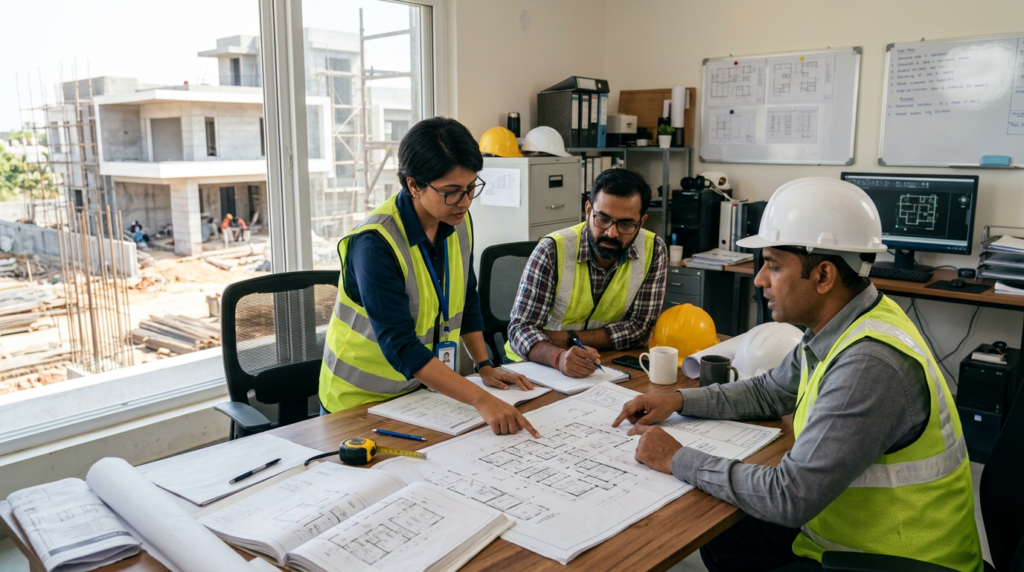
The simplest way to explain a full-service construction company is this: they replace the stack of separate contracts with one integrated agreement.
Under this model, you sign with one firm. That firm employs or directs the architect, the structural engineer, the project manager, and the construction teams. They manage sub-trades, procure materials, coordinate inspections, and handle BBMP compliance. You get one point of contact, one line of accountability, and one contract that defines what will be built, at what cost, and by when.
Here’s what changes:
Design and execution talk to each other. The architect and site engineer sit in the same room. When a structural requirement changes something in the floor plan, it gets resolved internally not through three weeks of email chains between independent professionals.
Material procurement is transparent. In a full-service model with a Bill of Quantities (BOQ) based contract, every material is specified upfront. The firm procures it. You’re not guessing whether the tiles your contractor bought match the grade you specified.
Project management is professional. Site visits aren’t optional. Progress milestones are tracked. The integration of digital technologies like BIM, AI, and IoT is creating new growth opportunities through enhanced design precision, collaboration, and operational efficiency and the better full-service firms in Bangalore have already adopted these tools.
Post-construction accountability exists. A full-service firm that builds your home has a reputational and contractual stake in it working correctly. Defect liability periods, structured handovers, and after-service support are part of the package in a way they rarely are with standalone contractors.
At Line of Thought, this is precisely how we approach every project whether it’s a full villa construction in Bangalore, a residential extension, or a comprehensive renovation. The architect, structural engineer, and site team function as one unit, not as separate vendors you have to stitch together.
When a Standalone Contractor Makes Sense and When It Doesn’t
Let’s be fair to contractors. They’re not the wrong choice for every situation.
When a standalone contractor works fine:
- Small repairs and maintenance. Repainting, minor plumbing fixes, floor tile replacement work that is simple, clearly scoped, and doesn’t require design input.
- Commercial fit-outs. If you have an approved layout and need execution-only work done in a commercial space, a specialist contractor can handle it efficiently.
- Additions to an existing structure. If you’re adding a room or extending a slab on an existing home, and you already have a trusted architect, a standalone contractor can work.
- When you’re a developer with in-house project management. Developers who run their own sites, manage their own procurement, and have experienced project managers can use contractors effectively.
When a standalone contractor is the wrong choice:
- New residential construction from scratch. The coordination requirements are simply too high for most homeowners to manage alone.
- Villa construction. Complex structures with custom finishes, specific material specifications, and multiple trades operating simultaneously need unified management.
- When you’re not in Bangalore full-time. If you can’t be on site regularly, you need a firm that manages the site on your behalf, not a contractor who checks in when convenient.
- When design quality matters. If your finished home needs to match a vision specific ceiling heights, material quality, spatial proportions, fragmented execution will erode that vision.
The honest question every homeowner should ask: “Do I have the time, knowledge, and presence to manage this project myself?” If the answer is no, a full-service firm is not a luxury, it’s a practical necessity.
How to Evaluate Building Contractors in Bangalore: A Due Diligence Checklist
If you’ve decided to hire a contractor or you’re comparing contractors as part of evaluating full-service firms here’s what actually matters:
1. License Verification Confirm they hold a valid contractor license from the Karnataka Contractors Association or an equivalent body. Ask for the license number and verify it independently.
2. Past Project Visits Don’t rely on photos. Ask to visit completed projects in person. Talk to the homeowners if possible. Look at the finish quality of tiles, plaster, woodwork joints, and electrical fittings these are where shortcuts show up.
3. Labour Management How do they manage their workforce? Are workers on payroll or hired daily? A contractor who relies entirely on daily-wage labour has less control over quality and schedule consistency.
4. Subcontractor Chain Who handles plumbing? Electrical? False ceiling? Ask for names. A contractor who can’t tell you who does their electrical work is someone who subcontracts blindly which means their quality guarantee is only as strong as their weakest sub-trade.
5. Safety Record Ask directly: have they had site accidents? How do they handle safety compliance? Proper scaffolding, helmets, and safety nets are non-negotiable. A contractor who dismisses safety questions is telling you something important about how they run their sites.
6. Payment Structure Standard payment terms for construction in Bangalore are milestone-based foundation completion, slab casting, brick work, finishing, handover. Be cautious of any contractor asking for more than 20-25% upfront. That’s a cash flow problem you’re being asked to solve.
7. Written Contract Everything must be in writing. Scope, specifications, materials, timelines, payment schedule, penalty clauses for delay. A contractor unwilling to sign a detailed contract is one who plans to renegotiate everything once your money is committed.
Understanding Labour and Material Contracts: What Every Homeowner Must Know
This is one of the least-understood aspects of residential construction in Bangalore and one of the most consequential.
Labour-only contracts mean the contractor supplies workers and supervision. You procure all materials yourself. This sounds like it saves money. Sometimes it does. But it also means you’re responsible for buying the right grade of cement, steel, sand, and aggregate and verifying that what arrives on site is what you paid for. Most homeowners are not equipped to do this.
Labour-and-material contracts mean the contractor supplies both workers and materials. This is simpler, but creates a different risk: you’re trusting the contractor to procure quality materials at the grades specified. Without a detailed BOQ and independent inspection, you have no way to verify what was actually used.
The BOQ-based contract is what serious full-service firms use. A Bill of Quantities specifies every material by grade, brand, quantity, and unit rate before work begins. There’s no ambiguity about what “M20 concrete” means or what brand of tiles should be used. Variations get documented and approved before they’re executed not after.
At Line of Thought, all projects run on a single BOQ-based contract. Every specification is locked in before ground is broken. This protects you from mid-project price surprises, material substitutions, and the most common source of construction disputes: “I thought this was included.”
A practical tip on material auditing: If you’re working with a contractor rather than a full-service firm, ask for supplier invoices for key materials cement, steel, and tiles especially. Cross-check quantities against what the BOQ or project drawing requires. Even basic auditing at three or four checkpoints can catch significant discrepancies.
Civil Engineering Companies in Bangalore: Their Role in Residential Construction
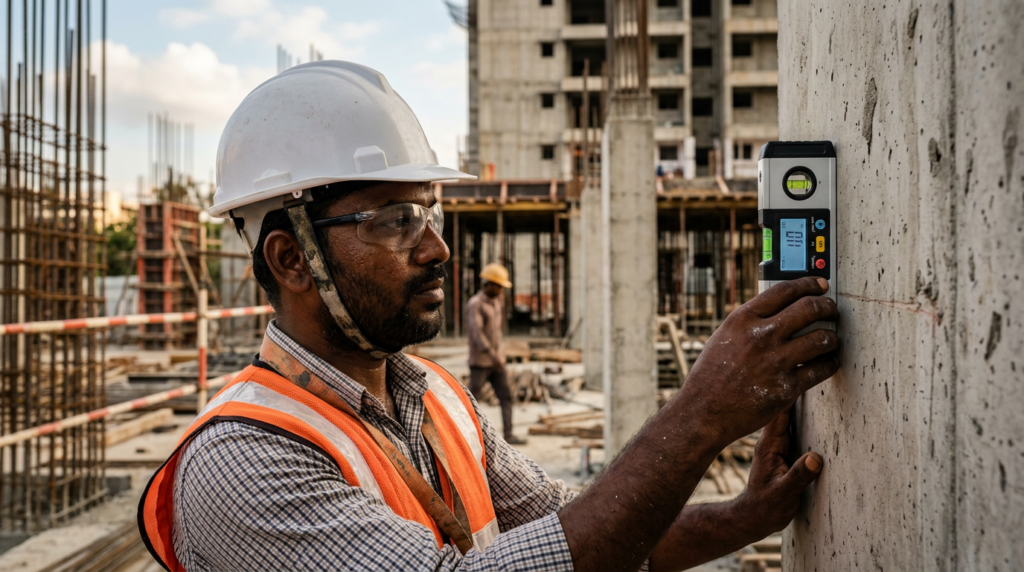
This section gets skipped in most discussions about contractors and builders but it shouldn’t. Civil engineering is not the same as general construction, and understanding the distinction helps you ask better questions.
A civil engineering company or licensed structural engineer brings specific expertise:
Soil testing and foundation design. Bangalore’s soil varies significantly across localities. What works in Whitefield may not work in Kanakapura Road. A proper soil investigation (borings, load-bearing capacity analysis) tells the structural engineer what kind of foundation the plot actually needs. Contractors who skip this step are guessing and guessing with your home’s structural integrity.
Structural design and drawing. Beam sizing, column placement, reinforcement specifications, slab thickness these are engineering decisions, not contractor decisions. An RCC design needs to be prepared by a licensed structural engineer and validated against the loads the building will carry.
Quality testing. Cube testing for concrete, bar bending schedules for steel, rebound hammer tests these are the quality checkpoints that confirm your structure is being built to specification. The adoption of smart building technologies, BIM, and 3D printing is enhancing construction efficiency and reducing costs in larger projects, but even for residential construction, basic quality testing at key milestones is non-negotiable.
BBMP compliance. Getting consent from the Bruhat Bengaluru Mahanagara Palike (BBMP) is one of the most crucial legal requirements before beginning construction. Homeowners can avoid legal issues, fines, and construction delays by being aware of the BBMP house construction approval process. A structural engineer registered with BBMP is required to certify your drawings before plan sanction can be granted.
The applicant or owner files an online application through a registered architect registered under BBMP, who uploads the Pre-DCR file (building plan in CAD format) of the layout along with the processing fee.
The BBMP building plan sanction process usually takes 30 to 45 working days, depending on the accuracy of your documents, project size, and the approval queue. That timeline assumes your documentation is complete and your drawings comply with current building byelaws which is precisely why having a structural engineer who understands BBMP’s requirements is so valuable.
In the full-service model, structural engineering oversight is built into the project from the start. You don’t hire a structural engineer separately and hope they coordinate well with your contractor. It all flows through one team.
Red Flags to Watch for When Hiring Any Construction Partner in Bangalore
This section doesn’t appear on most blogs, but it probably should. After years of working in construction and renovation in Bangalore, these are the patterns that consistently signal trouble ahead.
Vague quotations. “Construction cost per square foot” figures without a detailed BOQ are meaningless. The only quotation you should accept is one that specifies materials by brand and grade, and breaks down costs by element.
Reluctance to show previous clients. A firm confident in their work wants you to see it. One who hedges and delays on site visit requests usually has a reason.
No site engineer on payroll. If your contractor doesn’t have a qualified civil engineer supervising the site full-time, quality control is happening by eye not by measurement.
Unusually low per-square-foot pricing. Construction in Bangalore for a quality residential home runs across a range depending on finish level. If someone is quoting significantly below the market, either the scope is incomplete or the materials are being compromised.
No mention of BBMP approvals. Constructing without BBMP approval is considered illegal. BBMP can issue a stop-work notice, impose fines, or even demolish the unauthorized structure. Additionally, you may face issues during property registration or loan approval. Any construction partner who doesn’t raise this proactively is either inexperienced or hoping you won’t ask.
Payments tied only to time, not milestones. If a contractor asks for monthly payments regardless of work progress, you lose all leverage the moment work slows down.
The Real Cost of Getting This Decision Wrong
Let’s put numbers to this, because the financial stakes are higher than most people realize.
The premium and luxury residential segments, priced at INR 2 crore and above, are expected to thrive as discerning buyers prioritize spacious accommodations with convenient access to essential support infrastructure. Most villa construction projects in Bangalore fall in this bracket or above.
At that investment level, a 10-15% cost overrun which is common in fragmented contractor models translates to Rs. 20-30 lakhs or more above your original budget. That’s not hypothetical. It’s the lived experience of many homeowners who chose the cheapest contractor option and managed the project themselves.
Beyond money, there’s the time cost. A project that runs 8-12 months longer than planned because of coordination failures isn’t just inconvenient. If you’re paying EMI on a construction loan while living elsewhere, every delayed month has a direct financial impact.
And then there’s the quality cost which you discover last, after you’ve moved in. A slab that wasn’t cured properly. Plaster that cracks in the second monsoon. Tiles that weren’t set level. Waterproofing that fails in year three. These aren’t dramatic disasters. They’re slow, expensive disappointments that erode the joy of a home you spent years planning.
The right construction partner isn’t an expense. It’s the hedge against all of this.
Renovation in Bangalore:Does the Same Logic Apply?
Yes and in some ways, renovation carries even more risk in a fragmented model than new construction does.
When you’re renovating an existing home in Bangalore, the surprises are hidden inside the walls: outdated wiring, undersized plumbing, structural elements that weren’t built to current standards. A contractor hired only for, say, a kitchen renovation, is unlikely to flag an electrical panel that’s undersized for the new appliances they’re installing. That’s outside their scope, and they know it.
A full-service firm handling your renovation in Bangalore scopes the entire intervention before quoting it. They’re looking at what the renovation touches structurally, electrically, and plumb-wise not just cosmetically. The cost estimate might be slightly higher upfront. The total cost of the project, including rework, is almost always lower.
This is especially true for whole-home renovations, where design coordination between rooms is essential. If your interior designer, tile contractor, false ceiling contractor, and painter are all independent operators, the chances of someone’s scope affecting someone else’s work and nobody owning the problem are high.
Why Line of Thought Is More Than a Contractor We’re Your Build Partner
Line of Thought was built around a specific frustration the way residential construction in Bangalore fragments accountability and leaves homeowners managing complexity they didn’t sign up for.
As a full-service construction company in Bangalore, the model is genuinely integrated. The architect who designs your space works alongside the structural engineer who validates it and the project manager who builds it. There are no handoff gaps. No version-control problems where the contractor is working off an older drawing. No scope disputes between trades because every trade answers to the same project team.
Whether you’re planning a new villa build, a complete home construction from foundation to furnishing, a home renovation in Bangalore, or a high-end interior design project the approach is the same: one contract, one point of contact, one team that owns the outcome.
As your interior designer in Bangalore, we don’t treat interiors as a separate phase that gets bolted on after civil work is done. Interior planning starts at the concept stage, which means electrical points are placed for furniture layouts that are already decided, ceilings are designed around lighting positions that are already specified, and material lead times are factored into the project schedule from the beginning.
As a villa builder in Bangalore, we manage every element of the build soil testing, structural engineering, BBMP plan approval, construction execution, MEP coordination, and interior finishing under one unified project plan.
That’s not just a better process. It’s a fundamentally better outcome for you.
FAQs: Construction Contractors in Bangalore
Q1. What is the difference between a construction contractor and a full-service builder in Bangalore?
A construction contractor in Bangalore typically handles only civil execution they build based on drawings provided by your architect and are not responsible for design, approvals, or material coordination beyond their scope. A full-service builder manages the entire project lifecycle: architectural design, structural engineering, BBMP plan approvals, construction execution, interior finishing, and handover all under one contract and one chain of accountability.
Q2. How do I manage a construction contractor in Bangalore effectively?
Start with a detailed written contract that specifies materials by grade and brand, milestones with clear completion criteria, payment terms tied to milestones (not time), and penalty clauses for delays. Visit the site at least twice a week. Cross-check material deliveries against your BOQ. Keep a site register of daily work progress. Hire an independent civil engineer to conduct quality checks at key milestones foundation, slab, brickwork, and finishing. If you’re not able to commit to this level of involvement, a full-service firm is a more appropriate choice.
Q3. What are standard payment terms for construction contracts in Bangalore?
A standard milestone-based payment schedule for residential construction in Bangalore typically looks like this: 10-15% on contract signing, 20-25% on foundation completion, 20-25% on slab casting, 15-20% on brickwork and first-fix MEP, 15-20% on plastering and finishing, and 5-10% on final handover. Be cautious of any contractor requesting more than 25% before work has begun; that’s usually a sign of cash flow problems on their end.
Q4. What BBMP approvals do I need before starting construction in Bangalore?
Getting consent from the Bruhat Bengaluru Mahanagara Palike (BBMP) is one of the most crucial legal requirements before beginning construction. You’ll need a building plan approval (sanction), a commencement certificate, and after completion an Occupancy Certificate (OC). Without this, your building is treated as unauthorized and can legally be demolished. Depending on your plot’s location, approvals may come through BBMP, BDA, or BMRDA. The BBMP building plan sanction process usually takes 30 to 45 working days, depending on the accuracy of your documents, project size, and the approval queue.
Q5. What is a BOQ-based contract, and why does it matter?
A Bill of Quantities (BOQ) is a detailed document that lists every material required for your project by type, brand, grade, quantity, and unit rate. A BOQ-based contract locks these specifications in before work begins. This means there are no disputes mid-project about material quality, no surprise “that’s extra” conversations, and no substitution of inferior materials without your knowledge. It’s the foundation of transparent, accountable construction. Always insist on a BOQ before signing any construction contract.
Q6. How do I handle a dispute with my contractor in Bangalore?
First, check your contract and most disputes can be resolved by referring to the agreed scope, specification, or payment schedule. Document everything in writing: WhatsApp messages, emails, site photographs. If work has stopped or the contractor is unresponsive, send a formal written notice specifying the breach and requesting resolution within a defined timeframe. For serious disputes, the Karnataka Contractors Association and consumer courts are available options. The best way to handle contractor disputes, though, is to prevent them: a detailed contract upfront eliminates most of the ambiguity that disputes feed on.
Q7. What is the difference between a labour-only and a labour-and-material contract?
In a labour-only contract, you supply all materials and the contractor supplies workers and supervision. You take on material procurement responsibility and all the risk that comes with it. In a labour-and-material contract, the contractor handles both. The risk here is that without a BOQ, you can’t easily verify material quality or quantity. A BOQ-based, single-contract model with a full-service firm resolves both problems: the firm procures materials to agreed specifications, and you have contractual recourse if they don’t.
Q8. What should I look for when visiting a contractor’s completed projects?
Look beyond the aesthetics. Check the finish quality of wall-to-ceiling junctions, tile alignment and grout consistency, door frame straightness, plaster smoothness, and the quality of electrical fittings and switch positions. Go outside and look at the external plaster, drainage channels, and compound wall quality. Ask the homeowner directly: were there cost overruns? Were timelines met? How responsive was the contractor after handover? These are the questions that separate contractors who photograph well from those who actually deliver.
Q9. Is it more expensive to hire a full-service construction company in Bangalore compared to a standalone contractor?
On a per-square-foot headline rate, a full-service firm may appear slightly higher than a basic contractor quote. But the comparison is rarely apples-to-apples. A contractor quote often excludes design fees, approval costs, structural engineering, site management, and the inevitable variations that come from an incomplete BOQ. When you add all those real costs plus the cost of your time and the financial risk of overruns, full-service firms frequently deliver better total-project economics. For new villa construction and complex renovation in Bangalore, this is almost universally true.
Q10. How long does it take to build a villa or new home in Bangalore?
A standard independent residential villa of 2,000-3,500 sq ft in Bangalore typically takes 12-18 months from BBMP plan approval to handover, depending on design complexity, finish level, and whether the construction team is unified or fragmented. Projects managed by a full-service firm with integrated teams tend to run closer to the lower end of that range, because coordination doesn’t depend on multiple independent vendors aligning their schedules. BBMP plan approval itself adds another 30-60 days before construction can begin.
Key Takeaways
- A contractor executes. A full-service firm owns the outcome. The difference isn’t about cost, it’s about accountability, coordination, and what happens when something needs to be resolved.
- The multi-party contractor model in Bangalore places all coordination risk on the homeowner. If you can’t be on site regularly and don’t have construction expertise, this risk is significant.
- BBMP approval is not optional. Building without it exposes you to stop-work orders, fines, and demolition. Any construction partner worth hiring handles this proactively.
- Always insist on a BOQ-based contract. Vague per-square-foot quotes without material specifications are an invitation to disputes and substitutions.
- Structural engineering is not interchangeable with general construction. Soil testing, foundation design, and structural drawings require qualified civil engineers, not just experienced contractors.
- Renovation in Bangalore carries the same coordination risks as new construction. A full-service firm that scopes the full intervention prevents the “that’s not my scope” problem.
- Payment milestones protect you. Never tie payments to time alone. Milestone-based payments mean you hold leverage throughout the project.
- Red flags are real. Vague quotes, reluctance to share past clients, no site engineer, unusually low pricing any one of these should slow you down. Multiple should stop you.
- Line of Thought operates as an integrated EPC firm architect, structural engineer, project manager, and construction team under one contract, for construction, villa building, interior design, and renovation projects in Bangalore.
- The right construction partner is not an overhead cost. It’s the most important decision you make about how your home gets built and the best protection against the financial and quality risks of getting it wrong.
Line of Thought is a premium construction company in Bangalore offering integrated design, villa construction, interior design, and renovation services. If you’re planning to build or renovate and want to understand how the full-service model works in practice, visit thelineofthought.com or get in touch to discuss your project.